Environment
Water Sustainability
Policies and Our Approach
Water is a vital resource that supports human life and livelihoods, and the foundation of Suntory Beverage and Food's (“the Company”) business activities. While water is a renewable resource that will never disappear from Earth, only about 0.01% of the planet's water is freshwater accessible to humans.
On the other hand, global issues concerning water resources have arisen due to factors such as population growth, economic development in developing countries, and climate change. It is predicted that by 2050, approximately 5 billion people worldwide will face severe water shortages.* This worldwide water scarcity is intertwined with numerous issues, as water is used not only for drinking and domestic purposes but also extensively in food production.
At the top of Suntory Group Environmental Principles is “achieving water security.” We are advancing various initiatives to contribution to the healthy circulation of water in nature, with a view that encompasses the entire value chain.
-
*World Meteorological Organization (WMO) “The State of Climate Services 2021”

Sustainable Water Philosophy
As a globally-operating company that depends on and benefits from the water and as a company that operates globally, Suntory Group must earnestly address worldwide challenges and contribute to building a sustainable society.
Based on Suntory Group Environmental Principles, we have established the Suntory Group Sustainable Water Philosophy to guide our efforts in addressing water challenges in various regions around the world. Based on this philosophy, we develop and promote initiatives that are tailored to the water resources conditions in each area where we do operate.
Suntory Group’s Sustainable Water Philosophy (Established 2017)
Water is the most important ingredient of our products, as well as a precious shared resource. In order to achieve “water sustainability,” the first pillar of the Suntory Group's Environmental Policy, we want to share these values with all Suntory Group members and apply them where we operate in order to answer to our stakeholders' expectations.
- Understanding the natural cycle of water
We investigate watersheds around our sites to understand the local hydrological cycle, using a scientific approach when needed.
- Promoting environmentally conscious water use
We reduce the environmental impacts of water use on the natural water cycle by implementing 3R activities and returning water to nature after adequate treatment.
- Conserving watersheds
We conserve our watersheds and endeavor to improve local water quality and quantity in cooperation with stakeholders for a sustainable future.
- Engaging with the local community
We endeavor to support our community by fostering collective actions to solve water issues and enrich society.
Implementation Structure
Sustainability Committee
For more information on the Sustainability Committee, see Environmental Management
Targets and Progress
Targets and Progress at Suntory Beverage & Food
The Suntory Group established the Environmental Vision toward 2050 and Environmental Targets toward 2030 to provide clear direction to our environmental management. As we engage in greater efforts to address global issues and work toward the realization of a sustainable society, in April 2021 we revised the greenhouse gas (GHG) reduction targets in the Environmental Targets toward 2030, and in December 2021, we revised our water targets.
Targets
Toward
2030
- Reduction of water used in direct operation
Reduce the water intensity of production at our owned plants*1 by 20%*2 globally. In addition, explore reduction of absolute amount of water withdrawn in highly water stressed areas. - Water replenishment
Replenish more than 100% of water used in at least 50% of our owned plants*1 globally, including those in highly water stressed areas, through local water source conservation efforts. - Sustainable water use in raw ingredients
Collaborate with suppliers to improve water-use efficiency in the production of water-intensive key ingredients*3 in highly water stressed areas. - Water education and access to safe water
Expand water education programs and initiatives to provide safe water access for more than 5 million people. *4
2025
Progress
- Reduced per consumption of water by 23% compared to 2015
- Implemented water resource cultivation activities in 35% plants worldwide.
Plants located in highly water stressed areas, activities are implemented in 10% of these areas. - Gain and understand information on water management of tier 1 suppliers through Sedex.
- Water enlightenment program: 2,100,000 people
Provision of safe water: 500,000 people,
Total 2,610,000 people*5
-
*1Owned plants that manufacture finished products and excludes plants for packaging and ingredients
-
*2Reduction of water intensity of production based on 2015 baseline year
-
*3Coffee etc.
-
*45 million people is Suntory group's target
-
*5The total is Suntory Groups's progress.
Our Initiatives
Water Risk Assessment
The Suntory Group, which positions achieving water sustainability as a priority issue in its Environmental Principles, established the Institute for Water Science in 2003 and continually conducts various water-related assessments. With sustainable business operations in mind, the Company evaluated water stress in the countries where plants are located. The Company also takes into consideration water risk assessment when developing new businesses.
Water Risk Assessment of Suntory Group’s Direct Operation sites
1. Water stress situation at Suntory Beverage & Food in countries where direct operation sites are located
We identified the water stress situation in countries where direct operation sites are located using Baseline Water Stress, an indicator in the Aqueduct Country Ranking developed by the World Resources Institute. The Aqueduct Country Ranking is a global tool for uniformly assessing the water risk of each country.
| Baseline Water Stress | |
|---|---|
| Extremely high | – |
| High | Spain, Thailand |
| Medium-high | USA, Vietnam, Australia |
| Low-medium | Japan, UK, France, Malaysia, Taiwan |
| Low | New Zealand |
-
*Based on country scores for Baseline Water Stress as used in Aqueduct 4.0 Current and Future Country Rankings by World Resources Institute.
2. Water risk assessment at Suntory Beverage & Food in watersheds where direct operation sites are located
In addition to national-level water stress assessments, we also carry out water risk assessments for the watersheds in which our production sites are located, identifying priority sites for water risk management. The following outlines the assessment process and the progress in risk management.
Primary Assessment — Prioritization (Screening) of sites based on water stress assessment
The primary assessment was conducted using a method we developed based on the knowledge acquired during the Science Based Targets (SBT) for Water pilot study program* in which we participated in 2021.
As a first step, we identified materiality related to water based on the characteristics of the beverage industry. Through this, we found that the most critical materiality is the water availability in watersheds where direct operation sites are located. We also found that groundwater and surface water are the ecosystem services we depend on most.
Next, we assessed the risks related to water availability in all watersheds where our sites are located to narrow down the plants that need water risk management as a priority. For assessment, in addition to the indicator of the Aqueduct mentioned earlier, we also referred to the Water Risk Filter developed by World Wide Fund for Nature (WWF). From those tools, we adopted four indicators that we can use to assess risks related to water availability. These indicators were used to determine the water availability based on the ratio between the amount of water supplied to the watershed by precipitation and the amount of water demand in the watershed, estimated based on population statistics. Three of the four indicators assessed “current” water stress levels, such as Water Depletion in the Water Risk Filter. We defined the average score of three indices as the current water risk score. For the remaining indicator, we adopted the 2040 Water Stress of the Aqueduct, which estimates the water availability in 2040 based on climate change scenarios ,etc., as “future” water risk score. All indices are scored in five risk levels and we categorized sites in watersheds with average current water risk score of “5: Extremely High” and “4: High” as sites with “Extremely high water-stressed” and sites with future water risk score of four or above as sites with “Highly water-stressed.” The foregoing is based on Aqueduct 3.0 and Water Risk Filter 6.0.
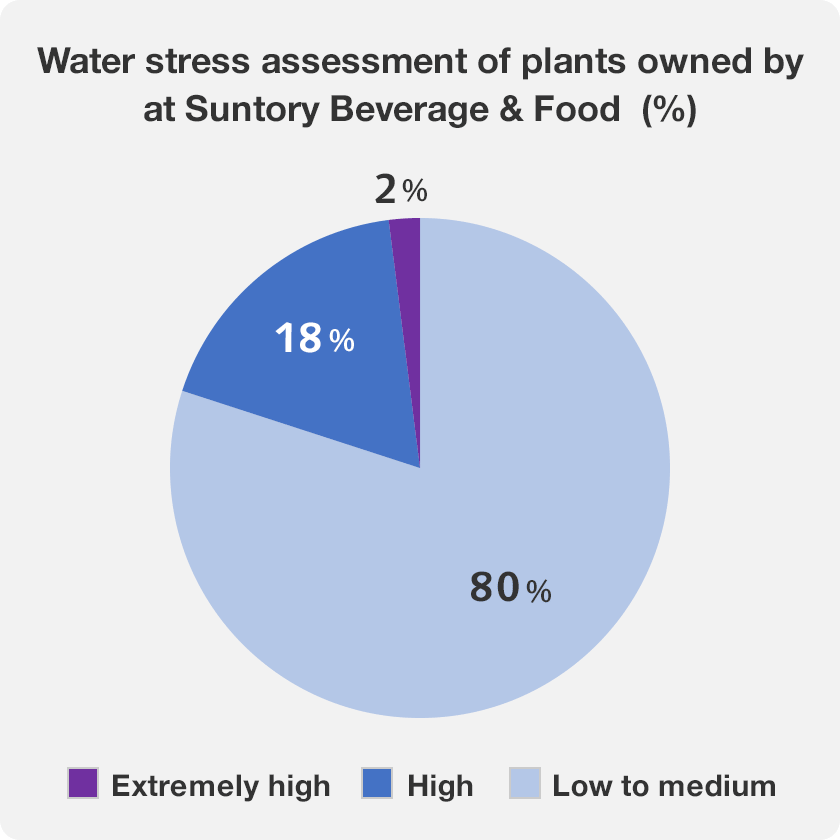
At Suntory Beverage & Food, supposing the total water withdrawal by all our plants in 2023 as 100%, 2% were by sites with “Extremely high water-stressed,” and 18% were by sites with “Highly water-stressed.” In the secondary assessment, we have set 20% of the plants as priority plants to prioritize in risk reduction.
-
*Pilot study to verify methodology related to SBT settings for water by Science Based Targets Network
-
Water Depletion of Water
Risk Filter (Five Levels)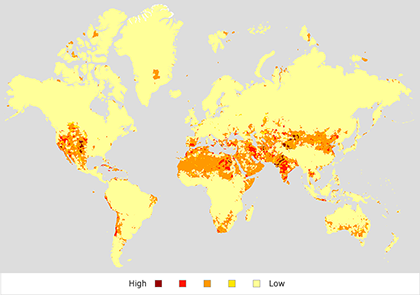
Source: Created based on Water Risk
Filter of World Wide Fund for Nature (WWF) -
A2040 Water Stress BAU
Scenario of Aqueduct (Five Levels)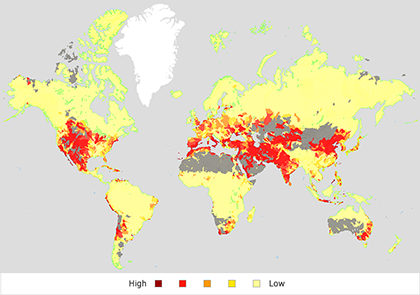
Source: Created based on Aqueduct
Project of World Resources Institute
Secondary assessment — Assessing the level of risk reduction measures at each plant
The level of risk reduction measures progress from the perspective of water management (water withdrawal and water-saving) and coexistence with the communities at sites narrowed down in the primary assessment as we assessed priority plants. Since the condition of the water resource is different in each watershed where our sites are located, we conduct measures to reduce risks that correspond with local conditions.
a. Water management (Water withdrawal and water-saving management)
As water is a precious resource shared with the community and ecosystem, our plants must manage water in a responsibly and appropriately.
Our plants water sources fall into two main categories: municipal and natural water (surface water and/or groundwater). Since municipal water is generally shared with various users in the community, its source area is extensive, and the local water authorities are the primary entity responsible for managing water withdrawal from the source. The plant needs to follow the water supply management policies and plans of the water authorities, including climate change adaptation plans, and promote appropriate water-saving management. On the other hand, if a plant uses natural water as a source, the primary entity responsible for managing water withdrawal is the plant, which has water intake inside the site. Therefore, the plant needs to take the initiative in water withdrawal and water-saving management to adapt to environmental changes such as climate change.
Based on the above points, we have assessed the level of measures progress to manage water withdrawal and water-saving at each plant. We evaluated the following two items:
(1) Water withdrawal management
The ability to prove that water withdrawal is managed properly (that water is not excessively withdrawn)
-
*Plants that use municipal water are not covered as the water authorities manage the water withdrawal
<Assessment criteria>
- The ability to collect the required water withdrawal data to demonstrate that water withdrawals are not significantly impacting local river and groundwater levels.
- Required water withdrawal data is being collected.
| Required water withdrawal data is not collected | : | Red |
| Part of the required water withdrawal data is collected | : | Yellow |
| All required water withdrawal data is collected, and water withdrawal is appropriately managed | : | Green |
<Assessment Results>
The following is water withdrawal management level of each plant represented as a pie chart. As a result of corrective actions taken at plants with assessed as having insufficient measures of progress, the percentage of plants at Suntory Beverage & Food whose progress level is Green has changed from 33% (December 2022) to 100% (December 2023).


(2) Water Saving Management
The ability to demonstrate that the progress of water saving activities is adequately managed
<Assessment criteria>
- Target was established to promote efficient use of water.
- Conducting activities to achieve the target yearly.
- Target is achieved yearly.
| No med-term target for water intensity | : | Red |
| No yearly target for water intensity or not achieved | : | Yellow |
| The yearly target for water intensity has achieved | : | Green |
<Assessment Results>
The following is the water-saving management level of each plant represented as a pie chart. As a result of setting a medium-term target and conducting water-saving measures to achieve the yearly target, the percentage of plants at Suntory Beverage & Food that have the water-saving management level of Green increased from 69% (December 2022) to 67% (December 2023).


We will continue to conduct measures to reduce risks using this process.
b. Coexistence with the community
As we are users of water as a shared resource with the community, Suntory recognizes part of the many stakeholders in the watershed; we aim to contribute to the development of the watershed society by conserving the water resource in each watershed to work hand-in-hand with the other stakeholders.
Precisely, following the roadmap for water source conservation efforts in the Environmental Targets toward 2030, we are identifying water-related issues in the watershed where our sites are located with local stakeholders. With the agreement of major stakeholders, we then begin conducting measures to conserve the water source area upstream of the site.
Based on the above points, we have assessed the progress of measures to co-exist with the community at each plant.
<Assessment criteria>
- Have identified issues related to ensuring water sustainability in the watershed.
- Have worked with local stakeholders to implement measures that contribute to resolving the issues.
| Water-related issues in the watershed are not identified | : | Red |
| Water-related issues in the watershed are identified | : | Yellow |
| Working with the community to resolve water-related issues in the watershed | : | Green |
<Assessment Results>
The following is the progress of measures related to coexisting with the local community at each plant, represented as a pie chart. As a result of steady efforts at each plant, 33% of the plants at Suntory Beverage & Food reached the level of Green (December 2023).


Rigorously Implementing the 3Rs to Reduce Water Use
Suntory Beverage & Food’s plants use a large amount of water, for example, in cleaning production equipment and cooling, and it is also used as an ingredient in our products. In order to conserve limited water resources, we rigorously Reduce, Reuse, and Recycle water — the “3Rs” — and are enhancing initiatives to achieve our 2030 target to reduce the water intensity of production at our plants worldwide by 20%.* We also rigorously implement the 3Rs when selecting plant equipment. At the Minami Alps Hakushu Water Plant of Suntory Products Ltd., a variety of 3R activities are being implemented. In particular, the company employees a “water cascade” recycling process, making it an industry leader in water usage per production unit.
-
*Reduction of water intensity based on the business fields in 2015
-

The Minami Alps Hakushu Water Plant of Suntory Products Ltd.
-

Reuse of water recycled at each stage of cleaning stored in 200-ton tanks
Water Cascade Recycling Process
Water used in the manufacturing process is classified into five grades based on quality, such as coolant water and cleaning water. This is a technology to reuse water in stages, from applications that require a higher grade to those that can be supplied at the next grade.

Strict Wastewater Management
The Suntory Group established voluntary standards for waste water that are equally or stricter than the legal regulations and manages quality so that we may release waste water in a state as close to nature as possible. Waste water from our plants is first purified using anaerobic waste water treatment facilities* and other equipment before it is released into sewers and rivers. Inspectors use measuring equipment to take daily readings of things like water quality under a constant monitoring regime.
-
*A treatment method that decomposes pollutants using microbes (anaerobic bacteria)

24-hour waste water management system
Water Source Conservation
We scientifically assess the regional water cycle where each Suntory Beverage & Food plant is located and implement site-specific water source conservation efforts in cooperation with local communities.
Suntory Natural Water Sanctuary (Water Source Conservation/ Preserving Biodiversity)
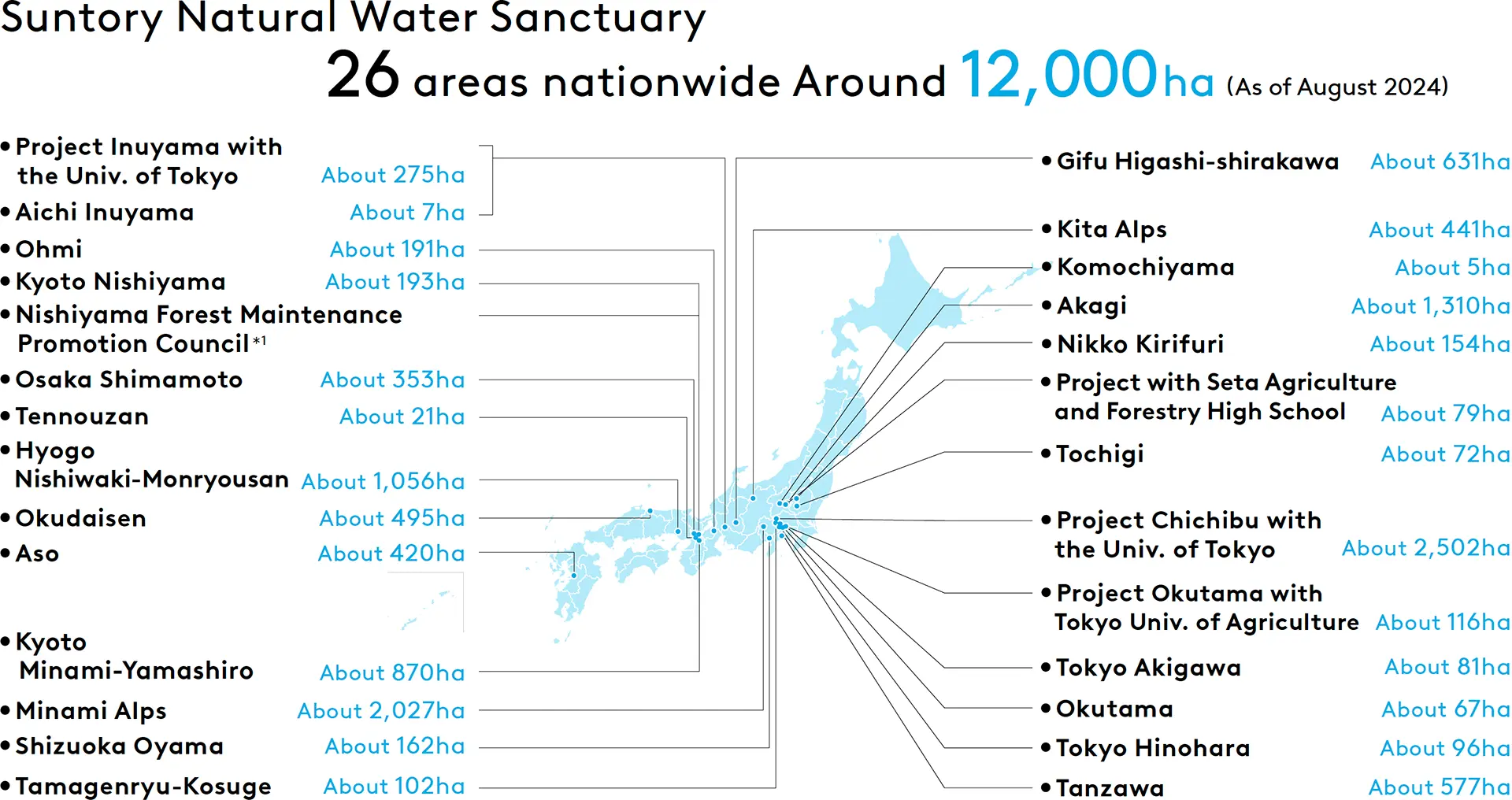
The Suntory Group started its Natural Water Sanctuary Initiative in 2003 to improve water resource cultivation and preserving biodiversity. The initiative has now expanded to more than 12,000 hectares in 26 locations in 16 prefectures across Japan, and is recharging twice the volume of water it pumps from underground at its owned plants in Japan. With the Suntory Institute for Water Science playing a central role, we are collaborating with researchers from various fields to carry out ongoing activities based on science, looking ahead decades or even 100 years into the future.
-
*1In Nagaokakyo, Kyoto, we are a member of the Nishiyama forestry development promotion committee and we are cooperating in local forest preservation activities with people in the community. The area of the forests subject to this activity is not counted as part of our total Natural Water Sanctuary area.
For more information, see Suntory Natural Water Sanctuary
Collaboration on Water Surveys with Various Stakeholders
At the Toledo Plant in Spain, we collaborate with a local NGO and a university in researching the ecosystem and conducting hydrological surveys to improve the water quantity and quality as well as to increase the biodiversity of the Guajaraz reservoir in the Tagus River basin through a project called ”Guardians del Taho.” In November 2023, the company signed an agreement with the City Council of Layos, Toledo for reforestation of approximately two hectares of municipal forest. Activities under the agreement will include reforestation and greening of land adjacent to the right bank of the Layos River from 2023 to 2025, with the aim of increasing biodiversity in the area, as well as fixing and fertilizing the soil to prevent erosion processes, reducing pollution diffusion, enhancing water infiltration capacity, and capturing atmospheric CO2. We will continue to follow the roadmap toward 2030 for water source conservation efforts and steadily conduct those activities.
We will also conduct Mizuiku — education program for nature and water at areas we perform these activities to teach the importance of conserving the water source to the local children who will lead the next generation.
Suntory Mizuiku — Education Program for Nature and Water
Suntory Group, which includes Suntory Beverage & Food, depends on water and nature’s other blessings. As such, the Group has implemented environmental initiatives such as the Suntory Natural Water Sanctuary to protect the forests that store water and pass on the beauty of clean water resources to the future. Another such initiative is the next-generation environmental education initiative called Suntory Mizuiku — education program for nature and water, started in 2004.
Suntory Mizuiku is an original program designed to help children appreciate the wonder of nature, realize the importance of water and the forests that store water, and consider what they can do to pass on clean water resources to the future.
Japan
Mizuiku education in Japan is centered on two programs: the Outdoor School of Forest and Water, offering shared hands-on nature experiences for parents and children, and the Teaching Program at Schools, a program for elementary schools.
Suntory Mizuiku — education program for nature and water received the Ministry of Education, Culture, Sports, Science and Technology’s Jury Award for Excellence for Companies Promoting Youth Experiential Activities in fiscal 2022.
-
*Sponsor: Ministry of the Environment, Ministry of Education, Culture, Sports, Science and Technology, etc.
Outdoor School of Forest and Water
This hands-on nature program, geared to elementary school students from grades 3 through 6 and their parents or guardians, is held in the home regions of (Mineral Water) Suntory Tennensui. Participants experience for themselves the importance of water and of the forests that produce it amid the great outdoors at Hakushu (Yamanashi prefecture), Kita Alps (Nagano prefecture), Okudaisen (Tottori prefecture), and Aso (Kumamoto prefecture). We also operate a remote school that enables participants to experience nature from home. The Outdoor School of Forest and Water staff conduct the program together with expert instructors who play active roles locally in environmental education.


Outdoor School of Forest and Water
Teaching Program at Schools
We offer study programs for students in grades 4 and 5 in elementary schools together with their teachers. We believe we can make a difference by teaching the cycle and importance of nature through videos and experiments, so that together we can pass down water to future generations. We also conduct online classes, and elementary schools all over Japan can participate.


Teaching Program at Schools
Suntory Mizuiku — Education Program for Nature and Water website
Vietnam
Since March 2015, we have offered a Mizuiku program in Vietnam.
In cooperation with international NGOs, we have developed original teaching materials, and since 2017 we have been working with the Young Pioneer Organization (CCYPO) of the Central Committee of the Communist Party of Vietnam. Moreover, since 2022, we have been collaborating with the Ministry of Education and Training to provide classes for elementary school students in grades 3 and 4 on the importance of water, water sanitation, and water source conservation. In addition, we are contributing to the installation of toilets and washrooms at elementary schools to improve sanitary environment of children.
This activity was created to contribute to Target 6.B of Sustainable Development Goal 6 “Ensure access to water and sanitation for all.”
In December 2022, Suntory PepsiCo Vietnam Beverage concluded a comprehensive collaboration agreement with the Ministry of Education and Training to deploy Mizuiku programs across Vietnam over a three-year period.


Suntory Mizuiku — Education Program for Nature and Water in Vietnam
Thailand
We have offered a Mizuiku program in Thailand since July 2019.
With cooperation from local NGOs, we are developing water awareness projects in elementary schools in the capital of Bangkok, as well as in Rayong and Saraburi provinces. We are also engaged in erosion prevention projects in the northern province of Chiang Mai and the southern province of Nakhon Nayok. By slowing stream currents, installing small weirs to support permeation of underground water, and planting trees to prevent soil from flowing into streams, we can prevent sediment-related erosion, and we plan to continue these efforts.


Suntory Mizuiku — Education Program for Nature and Water in Thailand
France
In July 2020, Suntory Beverage & Food France established a workshop-based water education program for elementary school students in partnership with Grand Parc Miribel Jonage, a nature park located near its Meyzieu Plant. The program includes content on the role forests have in cultivating water, experiments to show how rainwater becomes underground water, and more.
In 2017, Suntory Beverage & Food France initiated a 20-year water-conservancy partnership with Grand Parc Miribel Jonage. Together with the local community, we are promoting conservation activities in forests extending into the park, including protecting and nurturing the water and natural environment in areas near factories. We are also conducting Mizuiku educational activities in line with this partnership.

Workshop-based water education program in France
Spain
Since May 2022, we have been conducting a Mizuiku program in Spain. With support from local environmental experts, we are offering an educational program for elementary school students in the province of Toledo. The field activities are carried out in the natural environment of the Guajaraz reservoir in the vicinity of Toledo, where the main factory of Suntory Beverage & Food Spain is based and source their water from. The program teaches children the importance of water, such as by deepening their understanding of the natural water cycle and how it relates to their daily lives, how to use water responsibly, and the relationship between water and biodiversity, as well as provides training and ideas on how to preserve and improve the quality and quantity of water in the future.

Suntory Mizuiku — Education Program for Nature and Water in Spain
United Kingdom
In May 2023, we launched a Mizuiku program in the United Kingdom. In collaboration with a charitable organization that conserves the environment of local rivers, we are developing a nature experience program for children up to elementary school age and their families in the Severn River basin, the water source for the Coleford Factory. The program teaches students about the importance of water and water conservation, including basic knowledge about water and the water cycle, and the relationship between water and biodiversity.

Suntory Mizuiku — Education Program for Nature and Water in the United Kingdom
New Zealand
In May 2023, we launched a Mizuiku program in New Zealand. In collaboration with an NPO that works to preserve local river environments, we are developing on-site classes for elementary school students. The program conveys to students the mechanisms of nature and the importance of water, and covers basic water knowledge, including the water cycle, as well as ocean pollution prevention, including upstream river cleanup.

Suntory Mizuiku — Education Program for Nature and Water in New Zealand
Participation in Initiatives
International Water Certification by the Alliance for Water Stewardship (AWS)
In 2018, Suntory Group’s Suntory Okudaisen Bunanomori Water Plant (Tottori Prefecture) became the first in Japan to receive AWS International Certification, followed by the Suntory Kyushu Kumamoto Plant (Kumamoto Prefecture) in 2019 and the Suntory Minami Alps Hakushu Water Plant (Yamanashi Prefecture) in 2021. The Suntory Kyushu Kumamoto Plant obtained the highest “Platinum” certification in 2023, followed by the Suntory Okudaisen Bunanomori Water Plant and Suntory Minami Alps Hakushu Water Plant in 2025. In addition, as Japan's first corporate member of AWS, Suntory Group has signed onto a partnership with the same organization in February 2021 to raise awareness of water stewardship in Japan, build networks, encourage stakeholder participation, and develop sharable tools. Additionally, in March 2025, 5 Japanese member companies*, including Suntory, launched a working group called "Japan Water Stewardship Leadership Group (JWS)" to advance efforts to raise Japan's water conservation efforts to global standards.
- *MS&AD Insurance Group Holdings, Inc., Kurita Water Industries Ltd., Coca-Cola (Japan) Company, Limited, and Yachiyo Engineering Co., Ltd.
About AWS
AWS is an organization founded by corporations and NGOs, including the World Wide Fund for Nature (WWF) and The Nature Conservancy (TNC), to promote water sustainability on a global scale. AWS has developed certification in sustainable water use for factories around the world, and promotes water conservation and stewardship.
For more information, see Achieving the AWS Certification for Water Stewardship.
The CEO Water Mandate
Suntory Group endorsed the CEO Water Mandate global platform, which is a United Nations Global Compact initiative to support the prevalence, practice and informational disclosure of water sustainability at companies.
