
- Release number
- No.sfa0067
- Posted date
- 2026/3/24
- Category
-
- Culture / Sports
Shunske Sato(violin/conduct) announced winner of the 57th Suntory Music Award for 2025
Download PDF
 |
|
©eduardus_lee |
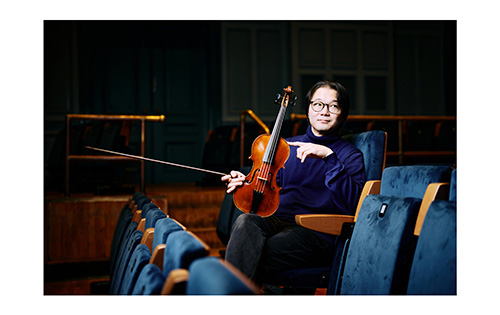
The Suntory Foundation for the Arts (Directors General: Tsuyoshi Tsutsumi and Shingo Torii) has announced Shunske Sato as the recipient of the 57th (2025) Suntory Music Award, which is presented to individuals or ensembles for notable contributions to the development of classical music in Japan.
▽Selection process
The first round of selections to choose candidates was held on Sunday, January 11, 2026 at the conference room of the International House of Japan. The competition continued with final qualifying round on Sunday, February 15, 2026 at the conference room of the International House of Japan. After long consideration, Shunske Sato was chosen as the winner of the 57th (2025) Suntory Music Award, a decision that received the formal agreement of the Board of Directors of the Foundation on Wednesday, March 11, 2026.
▽Prizemoney ¥7,000,000
▽The members of the selection committee
Nobuhiro Ito, Toshie Kakinuma, Morihide Katayama, Masaaki Suzuki, Motoyuki Teranishi, Atsuya Funaki, Ryoichi Matsumoto, Junko Yoshida
▽Reason for the award
Early Music or Modern? For violinist and conductor Shunske Sato, such questions—and the dichotomies are becoming increasingly obsolete.
Drawing on a profound respect for historical performance-style, scores, and instruments, paired with an inquisitive and forward-looking artistic spirit, Sato transforms the past into a limitless source of creative possibility. At its core, early music is an exploration of shared human experience—an art form that transcends borders and eras, and in doing so, reveals its inherent diversity. Sato’s fascination with early music took root during his teenage years in the United States. After extensive study, he now performs fluently on both period and modern instruments, treating them as equal facets of his artistic identity. His strong international outlook and multilingual ability have further enabled rich, flexible collaborations with musicians across the globe. Following his tenure as the sixth Artistic Director of the Netherlands Bach Society, he continues to broaden his international presence through performing, conducting, teaching, and mentoring—while actively cultivating the next generation of artists.
In recent years, Sato has brought significant artistic stimulus to the Japanese classical music scene. His appearances with the Tokyo Symphony Orchestra as guest conductor offered not only audiences but also the orchestra’s musicians a striking and transformative experience. His work with the Tokyo University of the Arts Chamber Orchestra, marked by improvisatory vitality and fearless musical engagement, expanded the perspectives of young performers and reaffirmed the joy of pursuing a life in music.
His nationwide Beethoven’s violin sonata cycles with Shuann Chai (fortepiano) indicated playfulness, intellectual curiosity, and artistic risk taking, encouraging audiences to listen actively rather than passively—an approach that left a notable imprint on the broader musical community. Last year, Sato founded the Past Forward Ensemble (PFE), a period instrument orchestra dedicated primarily to repertoire from the Romantic era onward. The ensemble will launch its inaugural performances this May in Cologne, Germany. True to its name, PFE aims to channel curiosity about the past into a creative force that shapes the future, stripping away entrenched assumptions and inviting both musicians and audiences into a more liberated musical experience.
At a time marked by division and uncertainty, Sato continues to demonstrate—clearly and compellingly—what only an artist can contribute. Music not merely as entertainment, but as a catalyst for reflection and deeper awareness.
This award recognizes his forward-looking vision and affirms the expectation that he will remain a vital force in shaping the future of classical music.
(Junko Yoshida, Committee Member)
▽Biography
Shunske Sato
Shunske Sato is a violinist, a conductor, chamber musician, soloist and teacher – the diversity of his activities reflect his versatile and resourceful nature. Historically informed performance practice is central to his identity and allows him to inhabit the music and communicate with audiences in dramatic, revelatory ways. He directs and appears as soloist with period ensembles as well as symphonic orchestras around the world, and has led several staged productions as well.
Resident in The Netherlands, Shunske has been a faculty member of the Amsterdam Conservatory since 2013, where he teaches historical violin. He also gives masterclasses and workshops with regularity. Sharing his knowledge with young musicians is very important to him, which is why he enjoyed the guest projects he did with, among others, the European Union Baroque Orchestra and the New World Symphony (Miami).
From 2013 to 2023 Shunske was artistic leader and concertmaster of the Netherlands Bach Society. During his tenure he directed numerous works by J.S. Bach, including large- scale works such as St. Matthew Passion and Christmas Oratorio, as well as Passion music by Graun, Graupner and Keiser. His many recordings of cantatas and instrumental works by Bach can be seen on www.youtube.com/bach. Other notable accomplishments include his own instrumentation of Bach’s Art of Fugue, collaborating with Opera2Day on an opera interweaving contemporary music and compositions by Bach, and video recordings of Bach’s Musical Offering which visually render the compositional structures using special effects.
Since 2011 Shunske has worked closely with Concerto Köln as soloist, conductor and concertmaster. Known for their interpretations of Baroque and Classical works, Concerto Köln has been making noteworthy strides into the realm of the 19th century: their recent undertakings include Wagner’s Ring of the Nibelung with Kent Nagano, Bruckner Symphonies, Paganini, Elgar and Tchaikovsky. With his experience in this repertoire and its performance practices, Shunske has been called upon as advisor, collaborator and soloist.
With his own PastForward Ensemble Shunske devotes himself to the realm of 19th century performance practice. The ensemble, formed by experienced European-based musicians, seeks to revisit the music of the 19th century and to bring it back to its emotion-driven roots.
Shunske is regularly invited to guest direct ensembles such as the Dutch Radio Philharmonic Orchestra, Australian Brandenburg Orchestra, the Tokyo Symphony Orchestra, the Residentie Orkest in the Hague, the Stavanger Symphony Orchestra (Norway), Orfeo Orchestra (Hungary), Philharmonia Baroque (USA) and Orquestra Barocca de Sevilla. Upcoming highlights include include a two-week residency in New York to lead a vocal instrumental Bach project at the Juilliard School, two solo recitals, and guest leading the Holy Trinity Bach Vespers.
Among the conductors with whom Shunske has collaborated both as soloist and concertmaster are Ivor Bolton, Richard Egarr, Philippe Herreweghe, Christopher Hogwood, René Jacobs, Ton Koopman, Kent Nagano and Hidemi Suzuki. Before historically informed practice became a part of Shunske’s activities, he performed extensively as soloist with renowned symphonic orchestras such as the Deutsche Oper Berlin, Bavarian Radio Philharmonic, Orchestre Philharmonique de Radio France, and the NHK Philharmonic Orchestra.
Born in Tokyo, Shunske immigrated to the US at the age of four. He studied at the Juilliard School in New York, Conservatoire National de Région in Paris and Hochschule für Musik und Theather in Munich. His teachers include Chin Kim, Dorothy DeLay, MasaoKawasaki, Gérard Poulet, Eiichi Chijiiwa and Mary Utiger. Shunske’s conducting mentors include Jos van Veldhoven, Hernán Schvartzman and René Gulikers.
See here for more on the Suntory Music Award
See here about the Suntory Foundation for the Arts
