
- Release number
- No.sfa0068
- Posted date
- 2026/3/24
- Category
-
- Culture / Sports
“Koshiro Hino New Concert piece Chronograffiti” announced winning performances of the 25th Keizo Saji Prize for 2025
Download PDF
 |
|
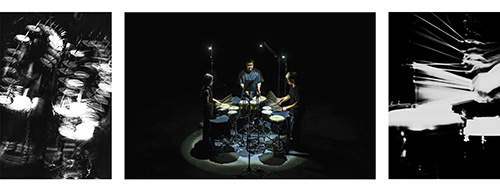
©Yuichiro Noda ©Yoshikazu Inoue ©Yuichiro Noda |
The Suntory Foundation for the Arts (Directors General: Tsuyoshi Tsutsumi and Shingo Torii) has announced that the 25th (2025) Keizo Saji Prize, bestowed on candidates selected from among those who gave predominantly music-based public performances held in Japan during the year, with winner chosen based on a willingness to challenge and on superior performance that engender a strong reaction, has been awarded to “Koshiro Hino New Concert piece Chronograffiti”.
▽Selection process
A qualifying round was held on Monday, February 23, 2026 at the conference room of the foundation to consider applicants who had given public performances in 2025. After long discussion, “Koshiro Hino New Concert piece Chronograffiti” were chosen as the recipient of the 25th (2025) Keizo Saji Prize, a decision that received the formal agreement of the Board of Directors of the Foundation on Wednesday, March 11, 2026.
▽Prize-money ¥2,000,000-
▽The members of the selection committee
Yuta Asai, Seiji Choki, Seiko Ito, Takayuki Komuro, Mikako Mizuno, Yoshihiko Nonomura, Yuji Numano, Akeo Okada, Miyuki Shiraishi
▽Outline
Dates & Times:
25 July 2025 7:30 PM / 26 July 2025 2:30 PM / 26 July 2025 7:30 PM / 27 July 2025 2:30 PM
Venue:
Black Chamber, Creative Center Osaka (Suminoe-ku, Osaka, Japan)
Program:
Bongo Trio - Taiko Solo - Loose Ends - Permutation
Performers: Tsuyoshi Maeda, Kanna Taniguchi, Tomo Ando (Percussion)
Composer: Koshiro Hino
Visual Effects: Ken Furudate
Stage Manager: Yuhi Kobayashi
Production Photography: Yoshikazu Inoue
Graphic Design: Takashi Makabe
Visual Effects Assistant: Ayane Sato
Project Manager: Akane Ban
Presented by TORITOMOKAI, LTD
Co-presented by Osaka Creative Chishima Foundation (KCV Selection)
Supported by Arts Support Kansai
▽Reason for the award
“Koshiro Hino New Concert piece Chronograffiti”
Chronograffiti is an astonishing immersive experience that integrates sound, visual elements, and bodily vibration using minimal means: a percussion trio or taiko solo, accompanied only by the simplest of lighting. The work is composed by Koshiro Hino, known as the leader of the experimental music band goat. Premiered in June 2025 at Moers Festival (Germany), the program has been revised for the acoustics at Black Chamber Creative Center Osaka. It consists of four movements: I. Bongo Trio, II. Taiko Solo, III. Loose Ends (a trio for three sets of bongos and congas), and IV. Permutation (a trio for three sets of bongos, congas, and toms). Notably, the third movement was newly composed for this revision, replacing a snare-drum duo that had appeared in the premiere. Visual effects are by Ken Furudate. Performers include classical and contemporary percussionists Kanna Taniguchi and Tomo Ando, as well as Tsuyoshi Maeda, formerly of Kodo. The collaboration of players with such diverse backgrounds is also a major source of the work’s compelling power.
The most important commendable point for this work was the overwhelming level of completeness achieved as a site-specific experience. Even the choice of venue was remarkable: a small hall, renovated abandoned warehouse at Osaka Bay, located beyond a maze of industrial streets. Out of the dusky, almost back-alley darkness emerged a kind of otherworldly, ritualistic environment woven from sound and light. Performers’ movements appeared in fragmented flashes under strobe lighting; delicate overtones from the bongos flickered overhead; and in the taiko solo, vibrations pierced deep into the listener’s body. that is “straightforward coolness” requiring no explanation—and That is why overwhelming any audience. Some committees who viewed the performance only by recording remarked that it was difficult to perceive something new in the work as a percussion piece. However, this opinion indicates that this work has the intensity of live performance out of the frame of a video. Indeed, the four committees at the venue unanimously gave it high marks. In the first movement, Bongo Trio, for instance, the shifting resonance was controlled with exquisite precision, producing overtones reminiscent of electronic sound—a subtle effect could be experienced only in the venue itself. The committees recognized that the piece was also musically innovative and that is what propelled this work to the prize.
Finally mentioned, that a large portion of younger generation occupied the hall, who has recently become decreasing at contemporary art music. This suggests that Hino’s work has the potential to reach broad and diverse audiences, opening doors to new listeners. It was an exceptionally distinguished performance, which inspired grand expectations for the future of Koshiro Hino as well as the team.
(Yuta Asai, Committee Member)
▽Biography
Koshiro Hino (Composer)
Musician and composer, born in 1985 in Shimane, Japan, currently based in Osaka. He leads the band goat, a rhythm ensemble consisting of guitar, bass, flute, and drums, in which all instruments are played percussively while combining multiple time signatures. The group is often described as “one of the tightest bands in the world.” He is also active with bonanzas, a band that reinterprets these ideas through a noise and hardcore lens, and with the electronic solo project YPY. His output spans a wide range of forms, including bands, dance music, and ensemble-based compositional works.
His major compositional works include “GEIST” (2018–), an immersive, spatial listening performance using multiple loudspeakers and moving performers; “INTERDIFFUSION: A Tribute to Yoshi Wada” (2021–), composed and performed with sound artist FUJI|||||||||||TA; and “Chronograffiti” (2025), a rhythm ensemble work that approaches minimalism through both visual and auditory perspectives.
Since 2019, he has collaborated extensively with the Sado Island–based taiko ensemble Kodo. Notably, he composed the entire score for the music film “Shiver” (2021, directed by Toshiaki Toyoda), created during a month-long residency on Sado Island, with performances by Kodo.
He is a member of ANTIBODIES Collective, founded by musician and director Toshio Kajiwara and dancer and choreographer Yoko Higashino, and has composed music for works such as Cindy Van Acker’s “Without References” and the feature film “The Invisible Fight” (2024, directed by Rainer Sarnet). He received the Best Composer Award at the Estonian Film Awards (EFTA) 2024 for The Invisible Fight.
Ken Furudate (Visual Effects)
Artist, engineer, and musician working across diverse media and disciplines—including sound, video, electronics, and textiles—centered around computers and programming. In 2002, he co-founded the participatory sound art project The SINE WAVE ORCHESTRA. Since 2013, he has been a member of Dumb Type.
In 2015, he launched Quasicrystal, a project exploring the creation of complex textile designs through algorithmic processes. In 2018, he received the Grand Prize in art division at the 22nd Japan Media Arts Festival for the sound installation Pulses/Grains/Phase/Moiré. In 2022, he participated in the exhibition at the Japan Pavilion of the Venice Biennale as a member of Dumb Type.
Through a wide range of expressive approaches, his work highlights the distinctive qualities of each medium.
Tsuyoshi Maeda (percussion)
Exposure to taiko began in childhood through cultural recovery initiatives following the Great Hanshin-Awaji Earthquake. In 2008, he joined the internationally acclaimed taiko performing arts ensemble Kodo, with which he toured extensively in Japan and abroad for approximately ten years, performing in more than 100 concerts annually.
During his tenure with Kodo, he performed taiko, vocals, flute, traditional festival instruments, and dance. He also worked as a composer and stage director, contributing to productions including the Sado Island Earth Celebration festival, Kodo’s nationwide school performance tours, and the special production Young Summer. He performed alongside Living National Treasure and Kabuki actor Tamasaburo Bando in Amaterasu and Yugen.
In Japan, he has collaborated with numerous artists across genres, including violinist Ikuko Kawai, enka singer Fuyumi Sakamoto, singer-songwriter AI, and composer/filmmaker Masakatsu Takagi, among many others. Since leaving Kodo in 2017, he has pursued an independent career as a solo artist, developing a distinctive musical voice rooted in his broad performance experience.
Kanna Taniguchi (percussion)
(From 2026, performing under the name Kanna Ashida)
Born in Kyoto in 1993, she graduated from Kyoto Horikawa Music High School and the Department of Percussion at Kyoto City University of Arts. She is active as a freelance musician, focusing primarily on chamber music while maintaining a strong commitment to interdisciplinary improvisation since her student years.
In recent years, she has concentrated particularly on the vibraphone. From the age of 23, she has been involved in numerous premieres and performances of contemporary works incorporating gamelan. Appearances include “Gifu Mirai Music Exhibition 2020: Akihiro Miwa Festival – Purified Night” (Salamanca Hall) and Suntory Hall Summer Festival 2023, Producer Series: “Akihiro Miwa Opens the Possibility of Gamelan.”
As a soloist, she performed with the Tokyo Philharmonic Orchestra in “Orchestra Project 2022.” Her first solo recital, “vib.” (2023), co-presented by Kyoto Art Center, featured five commissioned world premieres and was met with a sold-out audience. She continues to present solo recitals and commission new works for vibraphone.
She collaborated with Kojiro Hino at ROHM Theatre Kyoto’s “sound around 003” (2023), premiering “Phase Transition,” and has since appeared in Hino’s works “Song and Against Song” (2024) and “Chronograffiti” (2025).
Tomo Ando (percussion)
Born (June 14 1997) in Kashiwa, Chiba, percussionist and musician. He began studying piano and drums in early childhood, started composing at age 13, and later pursued formal percussion studies at Tokyo University of the Arts.
After graduation, he established himself as a freelance percussionist, appearing as a guest performer with orchestras throughout Japan, participating in contemporary ensembles, and performing as a soloist. In recent years, he has expanded his artistic practice through improvisation, composition, and live performance, often incorporating everyday objects alongside percussion instruments.
He was a finalist in the Contemporary Music Performance Competition “Kyogaku” and won First Prize in the Percussion Division of the 22nd Japan Wind and Percussion Competition. He is a member of the percussion trio “Trio Loop” and the improvisational music collective “LA SEÑAS.” He also composed and performed music for the exhibition “Kengo Kuma: A Sensory Architecture.”
His performance credits include appearances at Kanagawa Prefectural Music Hall’s “Momijizaka Project Vol. 2” and NHK-FM’s “Recital Passio.” He studied composition with Teiho and Nozomi Matsumoto, and percussion with Satoshi Takeshima and Takafumi Fujimoto. He is an endorsed artist of KOROGI Co., Ltd. (neoria) and BONNEY DRUM JAPAN.
See here for more on the Keizo Saji Prize
See here about the Suntory Foundation for the Arts
