


2026.10.08
Others Plant science StoryHow Do Plants Make Genes Acquired from Other Plants Their Own?
— Findings Presented at the 43rd Annual Meeting of the Japanese Society for Plant Biotechnology —
Suntory Global Innovation Center Ltd. (SIC) has revealed how a gene acquired by parasitic dodders (Cuscuta spp.) from another plant through horizontal gene transfer subsequently evolved within the dodder genome. The findings were presented at the 43rd Annual Meeting of the Japanese Society for Plant Biotechnology in Tottori, Japan.
Background
Dodders (Cuscuta spp. in Solanales) are obligate parasitic plants that grow by connecting to other plants. Previous studies have shown that dodders have acquired a variety of foreign genes from their host plants through horizontal gene transfer (HGT). Unlike ordinary inheritance, in which genes are transferred from parent to offspring, HGT allows genetic material to transfer between distantly related organisms.
While analyzing the genomes of multiple Cuscuta species, the research group focused on CYP81Q genes that are highly similar to genes encoding piperitol/sesamin synthase (PSS), an enzyme involved in sesamin biosynthesis in sesame and related plants of Lamiales.
Research Findings
1 A gene acquired from another plant remains functional
Genome analyses indicated that the CYP81Q gene was horizontally transferred from a host plant in the order Lamiales to an ancestral Cuscuta lineage.
The gene is expressed in seeds in which sesamin-related lignan metabolites are accumulated, and the encoded enzyme shows PSS activity when expressed in yeast. These results indicate that a gene acquired from another plant functions as PSS in Cuscuta.
2 Evidence supporting parasitism-mediated horizontal gene transfer
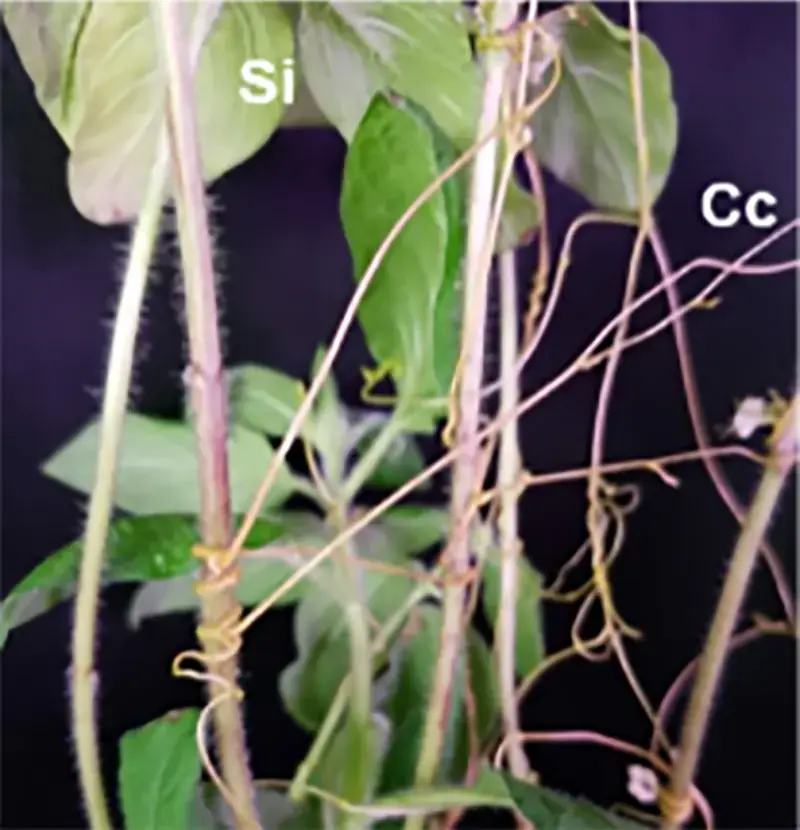
In sesame parasitized by Cuscuta, expression of the PSS gene was induced at the site of parasitism, and its transcripts were detected moving into Cuscuta stems. The researchers also confirmed that Cuscuta could flower and set seed while using sesame as its host.
Together, these observations provide important clues for understanding how dodders may have acquired genes from host plants through parasitism.
3 The acquired gene experienced structural remodeling
A comparative genomic analysis of CYP81Q showed that the gene underwent structural remodeling after horizontal transfer, including the sequential gain of additional introns. Transposable elements, or footprints of them, were consistently found within these regions.
This indicates that the foreign gene was not simply preserved unchanged. Instead, it underwent dynamic structural remodeling within the dodder genomes while retaining its enzymatic function. Of note, Dodder’s CYP81Q genes are located at the same position in their genomes, which is indicative of a single horizontal transfer event in a common ancestor of the dodders.
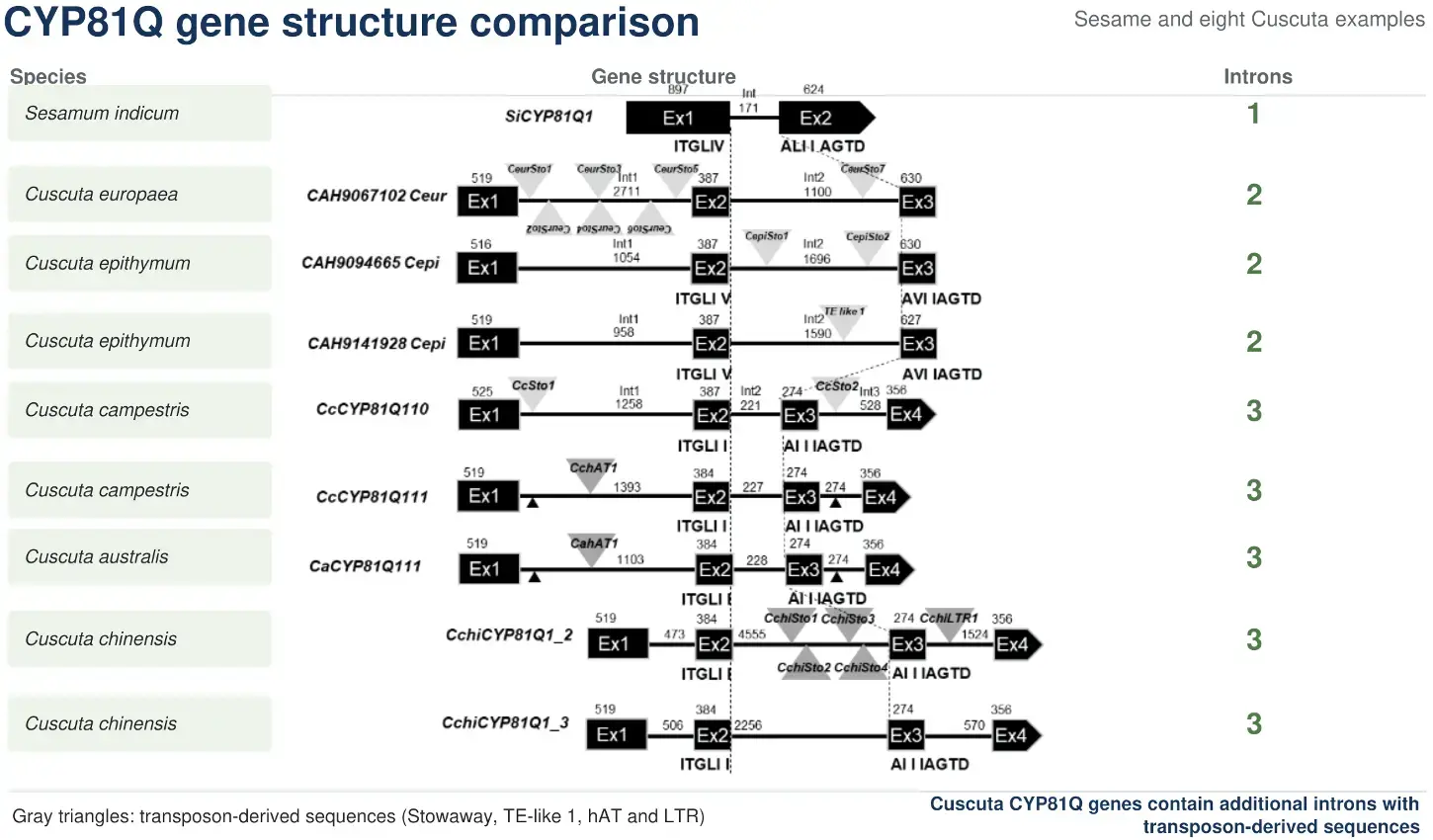
Comparison of one sesame CYP81Q gene and eight Cuscuta CYP81Q genes. Each row shows exons (Ex), introns (Int) and their lengths, as well as transposon-derived sequences within the introns.
Gray triangles: transposon-derived sequences (Stowaway, TE-like 1, hAT, and LTR)
Significance and Future Perspectives
The study shows that Cuscuta not only acquired a gene from its host plants through parasitism, but that the transferred gene continued to evolve in its new genomic environment while retaining its function.
Viewing HGT not simply as the movement of a gene across species boundaries, but also as a process in which the transferred foreign gene is subsequently accommodated, remodeled, and maintained in a new genome, can deepen our understanding of how plants acquire new genes and functions over evolutionary time.
Through the continued accumulation of such fundamental research, SIC aims to expand understanding of the diverse biological phenomena found in plants and accelerate further exploration of plant science.
Researcher's Perspective
“Dodders have developed an exceptional physical connection system with their host plants and have acquired a diverse array of foreign genes from them over evolutionary time. Our interest is not only in the fact that a gene can move across species boundaries, but also in what happens after it arrives. This study gives us a glimpse of how an acquired gene can be remodeled within a new genome while preserving its biochemical function. What do the structural changes that occurred in the foreign genes mean? This is the next question that remains to be clarified. ”
— Eiichiro Ono, Suntory Global Innovation Center Ltd.
Presentation Details
Conference:
The 43rd Annual Meeting of the Japanese Society for Plant Biotechnology
Dates:
September 4–6, 2026
Venue:
Torigin Bunka Kaikan and Tottori Civic Hall, Tottori, Japan
Presentation Title:
Genome analysis of Cuscuta spp. reveals the evolution of CYP81Q-mediated specialized metabolism through horizontal gene transfer
Authors:
Eiichiro Ono¹, Kohki Shimizu², Tenta Segawa¹, Jun Murata³, Hiromi Toyonaga³, Akira Shiraishi³, Masaki Takagawa⁴, Manabu Horikawa³, Ryusuke Yokoyama⁴, Atsushi Hoshino⁵˒⁶, Koh Aoki²
Affiliations:
¹ Suntory Global Innovation Center Ltd.
² Graduate School of Agriculture, Osaka Metropolitan University
³ Bioorganic Research Institute, Suntory Foundation for Life Sciences
⁴ Graduate School of Life Sciences, Tohoku University
⁵ National Institute for Basic Biology
⁶ The Graduate University for Advanced Studies, SOKENDAI
Related Research
1) Genome evolution in Cuscuta species
Chromosome-scale genome assemblies of two allopolyploid Cuscuta species uncover genomic signatures of parasitic lifestyle and polyploid evolution
Plant and Cell Physiology 67(4), 614–627 (2026)
https://doi.org/10.1093/pcp/pcag002
2) Evolution of the CYP81Q gene after horizontal gene transfer
Transposon-colonized intron gain follows parasitism-mediated horizontal transfer of a cytochrome P450 gene
Plant Physiology 201(2) (2026)
https://doi.org/10.1093/plphys/kiag335
SIC News Release: https://www.suntory.com/sic/whatsnew/news-release/article/20260908/
We share the latest news, announcements, and day-to-day activities at SIC. If you are interested, please follow our page to stay updated.
[Suntory Global Innovation Center Official LinkedIn]


