
Previous
1998-2002|The percentage of blue pigments increased to 100%; blue roses were finally born
2025.12.22
Others Plant science Story
In June 2004, we publicly announced the first success of the development of blue roses in the world, and showed them publicly in the press conference room.
This article is a re-edited version of an article that appeared on our corporate website in 2014. Job titles, department names, and photos are current as of the time of publication (2014) and may differ from the present.
In June 2004, Suntory announced that it had succeeded in developing the world’s first blue roses. The news spread rapidly around the globe. However, to produce and sell these roses in Japan, it was necessary to demonstrate—under the Cartagena Act—that the roses would pose no ecological risk and to obtain formal government approval. To verify that the roses would not crossbreed with wild species, the research team conducted a wide range of tests, including field experiments in open wilderness conditions, over a period of four years. This article looks back on the extraordinary press conference held at the time of the announcement, as well as the extensive behind-the-scenes efforts that ultimately led to regulatory approval in 2008.

We received huge responses. The success was reported on the front pages of various newspapers, and covered by mass media overseas. The general consumer was also greatly interested, and warm responses were received from many people, including elementary school students and the elderly. The stories of the development of blue roses are included in scientific textbooks, exhibited at the National Museum of Nature and Science, and used in many teaching materials. We published some papers on the scientific aspects of the development, and received the PCP Award of the Japanese Society of Plant Physiologists in 2009.
However, we had to overcome another and possibly the highest hurdle before delivering blue roses to consumers. Because the blue roses developed by Suntory are genetically modified organisms, it was necessary to obtain legal permits from the Ministry of Agriculture, Forestry and Fisheries and the Ministry of Environment based on Act on the Conservation and Sustainable Use of Biological Diversity through Regulations on the Use of Living Modified Organisms (so-called Cartagena Protocol) in order to grow them commercially and sell them in Japan.
For that purpose we had to conduct various experiments to prove that the production and sales of the developed roses in Japan would not affect Japanese biological diversity. For example, we spent as long as four years to conduct hybridization experiments including cross-pollinating the blue roses with wild rose species in order to prove that there was no risk of dispersal of the introduced genes among wild roses. We obtained the permits on January 31, 2008.

It was decided to hold a press conference on the success of the development of the blue roses in Roppongi Hills with the presence of the president, and with real blue roses exhibited. At that point of time, it was difficult to exhibit them because no permit for the genetically modified blue roses had been obtained and they could not be carried out of the specified laboratory as they were.
In consultation with officials of the Ministry of Education, Culture, Sports, Science and Technology, therefore, we put the flowers in a sealed container and temporarily converted the press conference hall to a laboratory compatible to genetically modified DNA experiments by installing filters in the ventilation holes. However, on the day of the conference, bullet trains were stopped due to heavy rain in Shizuoka, and the roses were not delivered by the trains.
We almost cancelled the conference, but the roses were carried by an airplane and arrived at the hall just before the conference. It was the first press conference for me, so I myself thought such a situation could occur occasionally. However, I later heard that the staff members of the Public Relation Department felt that the conference, which was full of unexpected incidents, would take several years off their life.
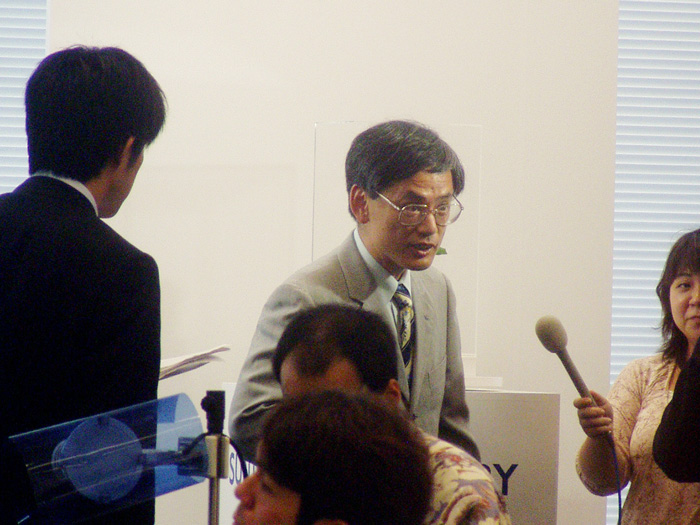
Usually people engaged in research and development don’t appear in a press conference. I had never thought that I would attract attention from media. As I was not used to that kind of occasion, I made some mistakes.
A reporter said to me, “They are purple, not blue, aren’t they?” and I should have said, “This is the blue color in the world of roses,” but I inadvertently said, “They are purple.” Because of my comment, a caption, emphasizing the word “Purple” in bold letters, was shown in a news program. I memorized Q & A that had been anticipated, but did not remember correctly how I should have answered other questions.
Still, we received excellent responses to the press conference. Our announcement was publicized extensively, and was even covered by the foreign mass media. From the next day, I was extremely busy dealing with a tremendous number of reporters.
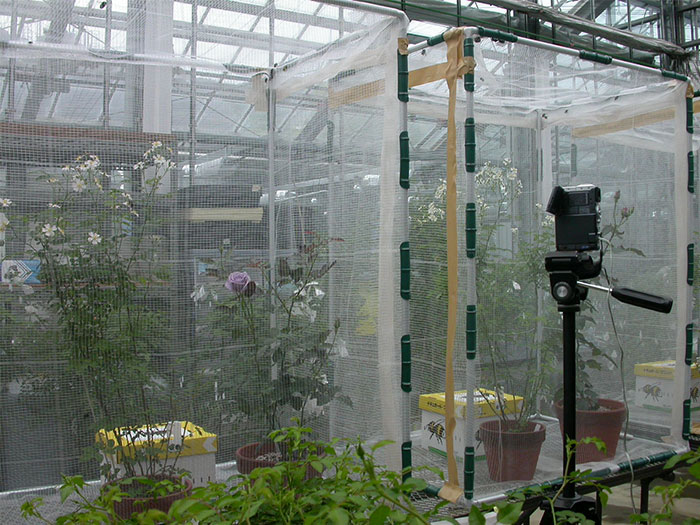
To produce and sell the genetically modified blue roses, we had to prove, as much as possible, the absence of effect on the ecological system in order to obtain the permits of the Ministry of Agriculture, Forestry and Fisheries and the Ministry of Environment. Unlike carnations, which rarely produce viable pollens if any, the roses produce many fertile pollens (pollens that have the ability to produce progeny by hybridization), and many wild rose species grow naturally in Japan. Therefore, the Ministry of Agriculture, Forestry and Fisheries wanted us to show that there was absolutely no effect, and conducted extremely strict examinations.
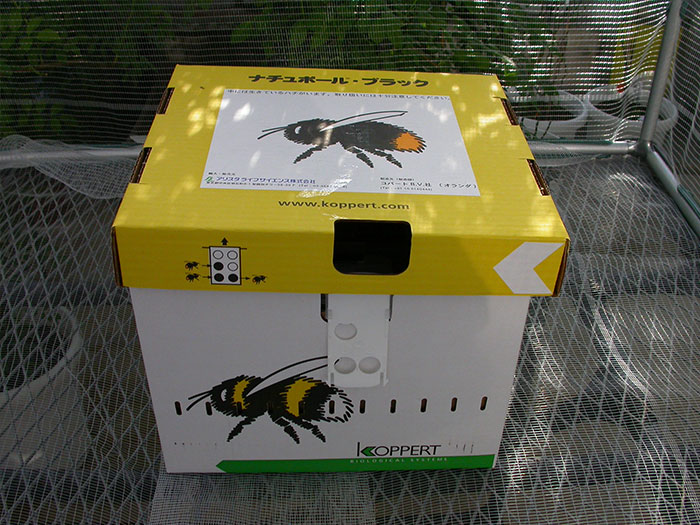
In experiments in a greenhouse, we actually released bees and studied if pollens were carried from the blue roses to wild roses. We also examined the distribution of wild roses around the experimental field, actually collected fruits within 500 m, and tested whether each one of the thousands of small seeds had been produced as a result of cross hybridization. This work was extremely laborious. For outdoor experiments, cooperation of residents in the surrounding areas was essential, and everybody supported us amiably.

The hardest experiments were “hybridization experiments” to examine the dispersal of the introduced genes by possible pollinating wild roses with the blue rose pollens. First we examined three representative kinds of wild roses. Considering the possibility that hybridization might be easier between plants with similar genome structures, it was decided to perform additional validation at places in which they grew naturally.
The species we selected was a rare one (Rosa acicularis), which grows naturally only in Tohoku District and in areas further north, and it was difficult to locate roses of this species. A rose lover told us about one farming field in Hokkaido, but it was in the wilderness in which there was a signboard, saying “Watch Out for Bears.” With many bees flying around the flowers, I, who disliked insects, patiently put pollen from blue roses (host) on the pistil of wild roses almost crying.
Perhaps because this sight was really rare, a fox (Vulpes vulpes schrencki) was watching us (Smile).

While I was conducting various experiments to obtain the permits necessary for marketing, I truly felt how much I was supported by many people, including those living around the experimental field. The network of rose lovers also helped me a lot. They not only taught me about the farming field in Hokkaido but also kindly surveyed and gave me copies of pages of a picture book with the shapes of rare rose fruits.
Although officials of the Ministry of Agriculture, Forestry and Fisheries told us that they would make a judgment carefully because there was no precedent, a public relations advertisement mentioned Suntory would release the roses as early as in 2007. Therefore, I had tremendous pressure, and the investigation on the distribution of wild roses in mountain areas was hard, but it was not a lonely endeavor. I knew that people outside of Suntory also supported the blue rose project, which was really reassuring.