
Previous
Chapter 3. Discovery The search for a new ingredient that would give rise to Tokucha tea
2025.12.22
Cutting-edge health innovations Health science Story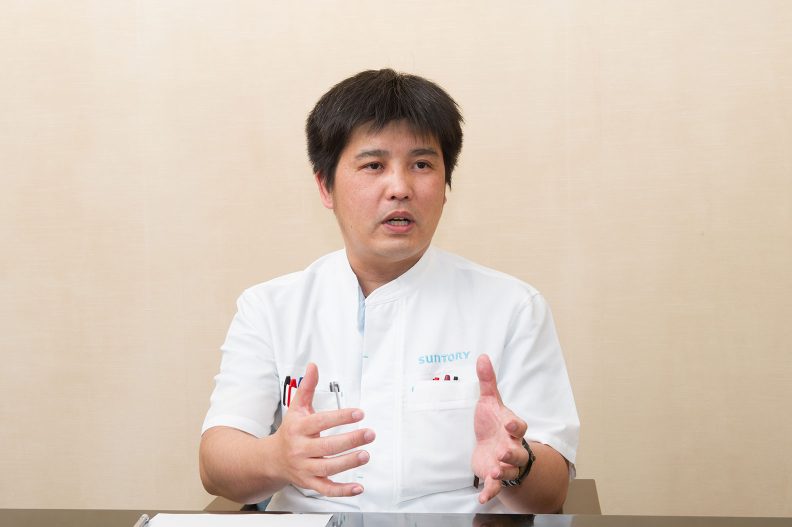
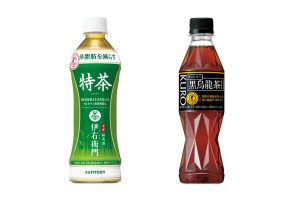
Suntory made a TV commercial with the tagline, "A tree trunk doesn' t burn well until you chop it into firewood. Body fat is no different." The quercetin glycoside added to Tokucha works by activating the enzymes that break down fat. It took many long hours for us to figure out how this function works, verify its effectiveness in humans, and get our FOSHU application approved.
We interviewed Norifumi Tateishi, Institute for Health Care Science, Suntory Wellness Limited.
This article is a re-edited version of an article that appeared on our corporate website in 2015. Job titles, department names, and photos are current as of the time of publication (2015) and may differ from the present.
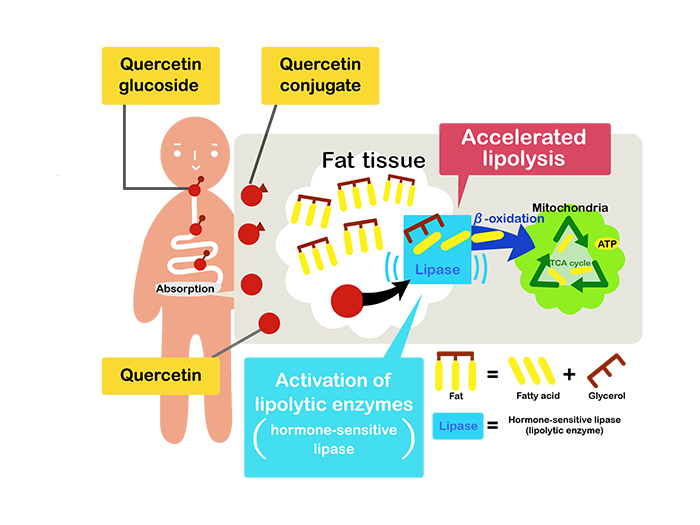
For Tokucha, it was essential not only to substantiate the health claim of reducing body fat, but also to clarify the mode of action—specifically, how the product activates hormone-sensitive lipase (HSL), a key lipolytic enzyme. Suntory was the first in the world to demonstrate that quercetin glycosides reach adipose tissue and activate HSL, thereby promoting the breakdown of stored fat. This scientific evidence and mechanistic insight supported the clear, memorable messaging used in our commercials—such as “bara, bara, bara” (“chop, chop, chop”) and “breakdown”—and became a major reason why Tokucha resonated so widely with consumers.
Quercetin is a type of polyphenol that can be found in things like onions, broccoli, and apples. It has gone by other names in the past, including vitamin P. Modern science has shown that it is not actually a vitamin, but the misnomer goes to show just how critical quercetin is to human health. I have personally been interested in quercetin for quite some time, thinking that it may offer health benefits in terms of blood and blood vessels.
Unfortunately, one of the properties of quercetin is that it does not easily dissolve in water, making it difficult to deliver in a beverage. It is also challenging in that the body does not readily absorb it. As we went forward with our research, we realized that we could improve water solubility by binding quercetin to sugar to create quercetin glycosides. The converted polyphenol is both a better beverage ingredient and easier for the body to absorb.
My job was to carry on the work of my predecessor, who had a hunch that quercetin would stimulate the breakdown of fats. I was charged with verifying the fat-reducing effects of the polyphenol as well as explaining the mechanism it used to do so. Prior studies had shown that dusting cells with quercetin dissolved fat, but hadn’t fully explained the molecular structure of the polyphenol or how it was triggering fat breakdown.
We were running around looking long and hard for the missing piece of the puzzle. We eventually figured out that when quercetin reached adipose tissue, it activated hormone-sensitive lipase, a lipolytic enzyme—and could at last explain the mechanism. Though quercetin itself was already well known, Suntory was the first in the world to figure out how its obesity-fighting effects actually worked.
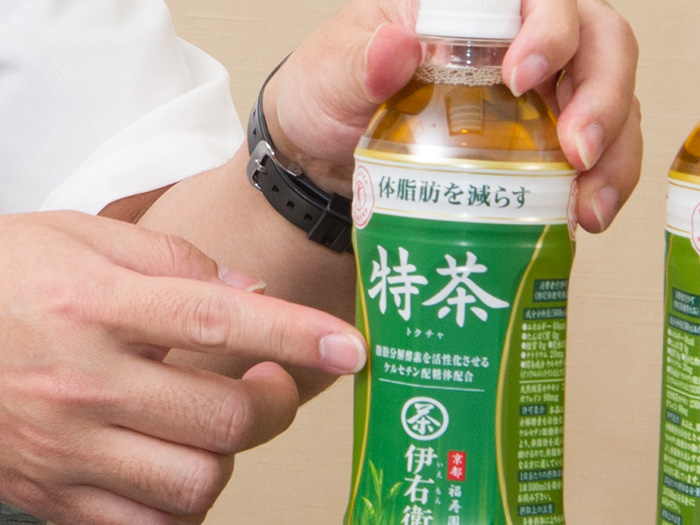
We now began to prepare in earnest to submit our FOSHU application for a beverage made with quercetin glycosides. The most important part of this process was collecting safety test data and verifying effectiveness in humans. We had to demonstrate that people could get a safe, reliable effect from consuming the product. Not only that, we had to explain the mechanism that caused it to work.
With Tokucha tea, we could make the health claim* that it “reduced body fat” once we verified safety and effectiveness—but without a clear mechanism for how it worked, we couldn’t indicate that it “contains quercetin glycosides to activate lipolytic enzymes.” Not being able to say that would mean that we couldn’t use our tagline: A tree trunk doesn’t burn well until you chop it into firewood. Body fat is no different.
In other words, the work of describing the mechanism is what allowed us to convert the scientific evidence we had collected into an actual health claim, which in turn made it possible to accurately communicate a clear message to consumers through advertising and other means. Essentially, my job was to scientifically back up our core message of “breaking down,” which was signified by our “bara, bara, bara…” (chop, chop, chop…) ad copy and featured images of shredders or wood choppers.
Being able to deliver a single, unified message to consumers is something that Suntory is tremendously well versed in and one of our company’s core strengths. I think we can credit the fact that so many people got on board with Tokucha to our exceptional ability to take sophisticated research findings or complex scientific reasoning and translate it into a message that is clear and relevant.
I have been working at the Institute for Health Care Science ever since I was transferred to Suntory from a pharmaceutical company. With drugs, it may be ten or twenty years from the time we’re involved with research and development until we can actually put a product on the market—so it’s rare that you ever get to see your work through from start to finish. Even with the supplements I’m working on now, it takes a long time for us to get things out to consumers. And since they’re sold through the mail, even when they do come out there are few opportunities to actually see customers using them firsthand.
With Tokucha, though, we get to see our customers reaching for our product on supermarket or convenience store shelves, and the joy of that moment is truly something special. To see a product I worked on displayed in stores and actually selling is a lot of fun, but the greatest joy is knowing that we actually succeeded in getting our product out into the world.
I feel incredibly lucky to be able to put my name alongside the other members of the Tokucha development project team and see our product actually out on the market. There is never any guarantee that the research you work on will end up translating into a viable commercial result.
I believe our success is due to the fact that our project team leader believed in the potential of quercetin and put together a grand strategy, and that our team members had the firm resolve to see that strategy through—working on research and development until we came to a definite result.
I was one of the central players up through the FOSHU application process, but the real heroes were those who made it through the lengthy and rigorous investigations that followed the submission of the paperwork. Finally, I believe that only Suntory could have provided the kind of corporate culture that allowed our research and development team to go up against these barriers and see the challenge through to the very end. It was that support that helped us all stick it out and eventually come out winners.