


News
Horizontal gene transfer gave dodder a sesamin-producing enzyme
2026.09.08
How foreign genes become integrated into parasitic plant genomes
Many plant species parasitize other plants by attaching to them and taking up nutrients that would otherwise be used by their hosts.
But sometimes, parasitic plants acquire more than nutrients—they acquire genes.
A new study shows that one such acquired gene was not simply preserved after entering the genome of the parasitic dodder (Cuscuta spp.). Instead, the gene underwent substantial structural changes over millions of years while retaining its original biochemical function.
The gene was acquired through a process known as horizontal gene transfer (HGT). Unlike ordinary inheritance, in which genes are passed from parent to offspring, HGT allows genetic material to move between distantly related organisms.
Drs Eiichiro Ono and Tenta Segawa from Suntory Global Innovation Center Ltd., together with Professor Koh Aoki and his team at the Graduate School of Agriculture, Osaka Metropolitan University, and researchers from the National Institute for Basic Biology, Tohoku University, and Bioorganic Research Institute, Suntory Foundation for Life Sciences (SUNBOR), traced the evolutionary history of the CYP81Q gene to investigate what happens to foreign genes after they enter the genome of a parasitic plant.
The researchers found evidence that CYP81Q originated from another flowering plant in the order Lamiales—which includes many medicinal and culinary herbs—and was transferred to the dodder lineage in the distant past.
The acquired gene provided dodders with a new biochemical capability. CYP81Q encodes an enzyme involved in the biosynthesis of sesamin, a plant lignan. After acquiring the gene, dodders gained the ability to produce sesamin themselves.
Over evolutionary time, the foreign gene underwent structural changes in the dodder genome involving transposable elements, sometimes referred to as “jumping DNA.” Sequences derived from these elements became incorporated into CYP81Q.
One of these sequences eventually contributed to the formation of a new intron—a section of a gene that is removed from its RNA transcript before the genetic information is translated into a protein.
Despite these substantial structural changes, the gene remained functional. The remodeled CYP81Q continued to encode an active enzyme capable of synthesizing sesamin.
The findings show that horizontal gene transfer is not necessarily the end of a gene’s evolutionary story. After entering a new species, a transferred gene can continue to evolve within its new genomic environment, becoming structurally integrated while retaining its original function.
For parasitic plants, this process may be particularly important. Their intimate physical connections with other plants provide unusual opportunities for genetic material to cross species boundaries. Once transferred, these genes can become raw material for further evolutionary change.
“The story of CYP81Q goes beyond a parasitic plant simply ‘stealing’ a useful gene. What we found particularly interesting is what happened after the transfer: the gene was extensively remodeled within the dodder genome while retaining its original enzymatic function. We see this as a kind of genomic domestication, in which foreign genetic material is not merely acquired but gradually becomes integrated into, reshaped by, and inherited as part of its new host genome. In that sense, horizontal gene transfer may mark not the end of a transfer event, but the beginning of a new evolutionary history.”
— Dr Eiichiro Ono, Suntory Global Innovation Center Ltd.
The findings were published in Plant Physiology, Volume 201, Issue 2, June 2026
(https://doi.org/10.1093/plphys/kiag335).
This study represents a fundamental research achievement by Suntory Global Innovation Center Ltd. (SIC), building on the dodder genome analysis reported in Plant and Cell Physiology, Volume 67, Issue 4, April 2026
(https://doi.org/10.1093/pcp/pcag002).
Summary
Parasitic plants can acquire genes from other plants and subsequently remodel and integrate them into their own genomes. The study shows that, despite substantial structural remodeling over evolutionary time, an acquired gene can retain its original biochemical function.
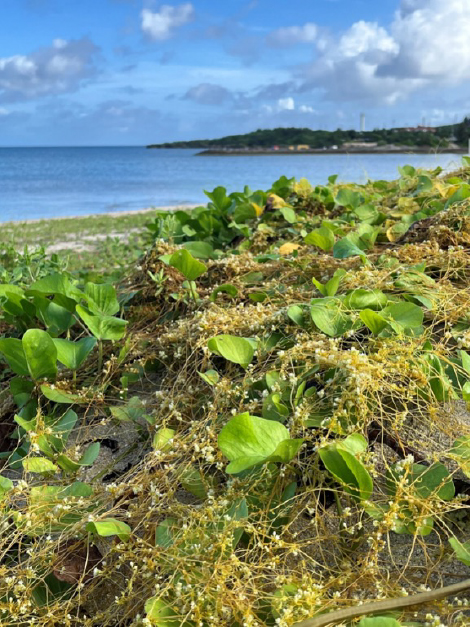
Graphic
Title: A parasitic dodder in bloom in Yomitan, Okinawa.
Caption: A dodder parasitizes a beach morning glory (Ipomoea pes-caprae), stealing nutrients and genetic material from its host.
Credit: Suntory Global Innovation Center Ltd.
Usage restrictions: News organizations may use or redistribute this image, with proper attribution, as part of news coverage of this paper only.
Journal Information
Journal: Plant Physiology
Title: Transposon-colonized intron gain follows parasitism-mediated horizontal transfer of a cytochrome P450 gene
DOI: 10.1093/plphys/kiag335
Author(s): Eiichiro Ono, Kohki Shimizu, Jun Murata, Tenta Segawa, Akira Shiraishi, Ryusuke Yokoyama, Hiromi Toyonaga, Masaki Takagawa, Manabu Horikawa, Atsushi Hoshino, Koh Aoki
Publication date: 30 June 2026
URL: https://doi.org/10.1093/plphys/kiag335
We share the latest news, announcements, and day-to-day activities at SIC. If you are interested, please follow our page to stay updated.
[Suntory Global Innovation Center Official LinkedIn]
