
Previous
Interview with a functional ingredient research scientist: exploring new functional ingredients to support better health
2025.12.22
Others Plant science Story
This article introduces the work of a researcher and developer of plants at Suntory Global Innovation Center.
This article is a re-edited version of an article that appeared on our corporate website in 2014. Job titles, department names, and photos are current as of the time of publication (2014) and may differ from the present.
Suntory took on the challenge of creating blue roses—a symbol long regarded as impossible—and succeeded in developing the world’s first roses capable of accumulating true blue pigment. However, the color of the flowers still turned out a pale blue-purple. Not satisfied with this milestone, Naoko Okitsu, a researcher leading plant biotechnology development, continues to pursue her dream of producing roses that are unmistakably blue. She devotes herself to this work each day, inspired both by the excitement of attempting something no one has achieved before and by the thought of the joy that truly blue roses will one day bring to customers.
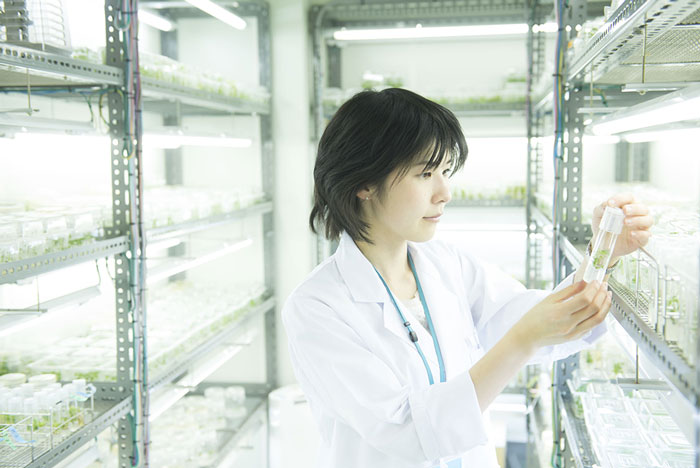
I am involved in a project to make blue roses bluer. SUNTORY blue rose APPLAUSE, the world’s first blue rose developed by Suntory, was released in 2009. However, its flower color is still pale blue-purple. I am now working on my research daily with the goal of producing roses that are blue in color to everyone’s eyes. The blue rose is a dream rose that rose breeders around the world have been unsuccessful in producing for over 800 years and is synonymous with the impossible. The reason for this is that roses do not have the ability to produce blue pigment, which is the reason for the blue color of a flower.
The blue roses now on the market were created by using genes from other blue flowers to make blue pigment in roses. This was a very innovative achievement in the research world. However, our challenge will not end until we create a rose that is even bluer than the blue-purple rose. I now work every day on experiments to discover how the blue pigment is enhanced in blue flowers, something that happens in other blue flowers, to find the gene that causes it, and to see if that gene can be used to produce even bluer flowers.
Ever since I joined the company, I have been involved in research on turning the color of flowers blue, and have been working on the development of bluer roses and bluer carnations. In addition to my research activities, I am also involved in public relations activities, such as being interviewed by the media and giving lectures outside the company as a senior “rikejo” (abbreviation of “rikei joshi,” a term that means women in science-related fields).
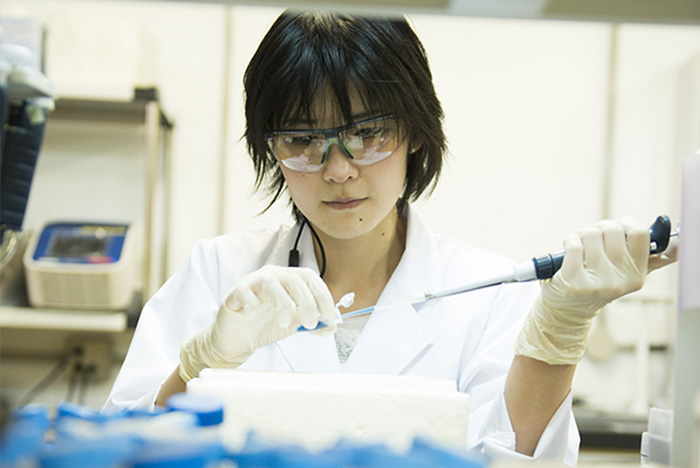
The blooming of pink flowers from a rose seedling that I had watched grow for a year, believing it would have blue flowers. I was prepared for the fact that this was a challenging job that would not be an immediate success, but at the time it was a real shock. However, I continue the challenge every day based on the creed “No matter how many times I fail, I will not give up! I will not give up in the middle of a project! I will finish what I started!”

I would like to bring happiness, surprise, and excitement to our customers. I want to keep challenging myself to do things that no one has accomplished before, as symbolized by the development of the blue rose. Right now, for me it is all about blue roses. I will do my best in my current job, always keeping the customer in mind.
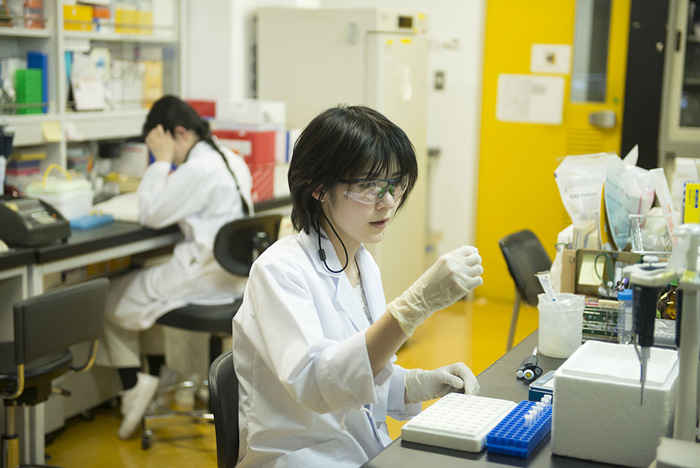
| 8:30 | Arrive at office Check schedule and notices |
|---|---|
| 9:00 | Experiments Theme creation activities |
| 12:00 | Lunch |
| 13:00 | “Plants” theme progress meeting |
| 17:30 | Confirm next day’s experiment schedule and preparation Join English study group |
| 19:00 | Leave the office |