



-
Photographic Report
Cyprus, the Island Where Division and Tranquility CoexistNobuyoshi Ito -
Commentaries
"Liberal Tyranny" in Japanese SocietyTsuyoshi Kamimura -
White Smoke and Newspapers — Reflections on the Fate of Media Tomoko Matsunaga -
Kenji Nakagami and Contemporary Japanese Literature Eri Watanabe -
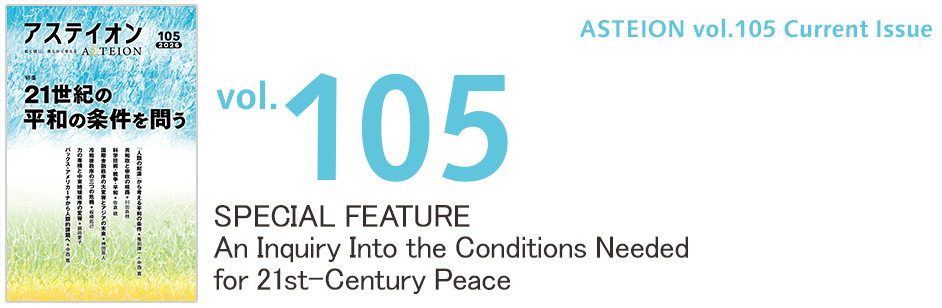
Special Feature:
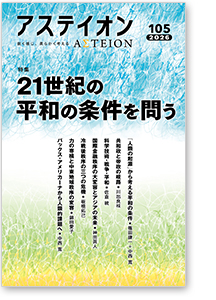
An Inquiry Into the Conditions Needed for 21st-Century Peace
PrefaceHiroshi Nakanishi -
Conditions for Peace from the Perspective of Human Origins Hiroshi Nakanishi questions
Ken'ichi Shinoda -
The Crossroads of Republic and Empire
— Ancient Rome and Contemporary America Through the Lens of Political ThoughtYoshie Kawade -
Science and Technology; War and Peace — The Promise of the Small-Scale Public Sphere Osamu Sakura -
Transformation of the International Financial Order and the Future of Asia Masato Kanda -
Three Crises Facing the Post-Cold War Order
— Clues to the Conditions for Peace as Seen in the Case of Unified GermanyTakumi Itabashi -
Abuse of Power and the Transformation of the Middle Eastern Order Aiko Nishikida -
From Pax Americana to Existential Global Challenges Hiroshi Nakanishi -
Articles
Restoring the Rule of Law in the International Trading System
— Rebuilding the WTO Regime and BeyondTsuyoshi Kawase -
From "Expanding Operations" to "Learning From Abroad"
— The Next Phase of Globalization for Japanese CompaniesKeiko Ito -
Essays
What Were Jomon-Period Dwellings Really Like?Terunobu Fujimori -
The People Who Won't Be Replaced by AI Mutsumi Imai -
Is There in Animals? Hiroki Koda -
On Professor Sasuke Nakao and His Botanical Writings Daisaburo Okumoto -
A Present-Day Form of Prewar Higher School Culture — The Dormitory Song and "Storming" Custom at Hokkaido University's Keiteki Dormitory Hiroshi Watanabe -
Photographic Report
Creating a Terraced Rice Field Where Fireflies Flit About on a University Campus — Protecting Biological Diversity in the Greater Tokyo AreaHiroichi Yanase -
Correspondence
The Feelings of Ordinary Israelis as the Ultimate BulwarkTaro Tsurumi -
To Be an Expert on Russian Thought Now Ruri Hosokawa -
The Indian Ocean and Africa — The Tanzania Connection Yoichi Mikami -
The Power of Aboriginal Art and the Course of Reconciliation in Australia Sachiko Kubota -
Cockfight Gamblers at the Bottom of Taal Lake Fumiko Morota -
Encounters with Japanese Literature in Faraway France Masatsugu Ono -
Book Review
How Did the Japanese Economy Finance Japan's Wars?Masayuki Tadokoro questions Keishi Ono -
Essays
The Symptoms Come After the Battle Is OverAnna Toi -
"Storied" Kyoto Toko Sawada -
The Closing of the Osaka Shochikuza Theater
— From "Great Osaka" Modernism to Some Sort of Minami Culture Museum?Setsuya Hashizume -
The Story of a Play Performance by Authors Anna Ogino -
Series
A Colette Style of Living
Final Part. An Analysis of "Claudine at School"Shigeru Kashima

Asteion was launched in 1986, a time when intellectual endeavor was still being held back by competing ideologies. Things have moved on since then. By adopting a more flexible approach and tuning our senses to a broad range of global issues, rather than churning out articles focusing solely on current affairs, we have developed a keen understanding of contemporary trends. The name Asteion comes from the Ancient Greek "ASTEION," meaning sophisticated and refined. This reflects our desire to stimulate intelligent discourse among those who are independent and yet share the same public space as fellow citizens through active but sensible exchanges of diverse opinions. A quarter of a century on, the competing ideologies that marked the twentieth century have now converged, leaving us free to express our opinions on an endless range of subjects. Our mission to promote genuine debate is all the more important for shedding light on the mega-waves of our time. We hope that more and more people, each interested in public issues in their own way, will come to share the spirit of Asteion and support our efforts. Masayuki Tadokoro Chair, Asteion Editorial Committee


|
|---|

 list
- Vol.104 Chinese Characters, Chinese Words, and Literary Chinese in East Asian Civilization
- Vol.103 Sending Japanese Culture Out Into the World — Tradition and Possibility
- Vol.102 Academic Journalism II
- Vol.101 The COVID-19 Pandemic Through the Lens of Economics
- Vol.100 An Arena for Intellectual Opinion and Debate:Commemorating One-Hundred Issues
- Vol.099 Artists Crossing Borders
- Vol.098 A Historical Perspective on the “Chinese Dream”? : The Extent of the Sinosphere in East Asia
- Vol.097 The Ukraine War: A Global Perspective
- Vol.096 Common Sense in Economics, Common Sense in Popular Thought
- Vol.095 Academic Journalism
- Vol.094 Once Again, What Are Today’s Problems?
- Vol.093 A New American Century?
- Vol.092 The “Patchwork” Order Encompassing the World
- Vol.091 The Future as Possibility – Japan in 100 Years
