
Our Policies and Approach
For Suntory Group, the global environment provides an essential foundation for our business. As a company dedicated to delivering the blessings of water and nature to our customers, we recognize our significant responsibility to protect ecosystems, including beautiful and clean water, and to pass on a sustainable society to future generations.
To realize a rich and sustainable society, Suntory Group has committed to preserving and regenerating the natural environment and to reducing environmental impacts across the entire Group. To guide these efforts, we established the Suntory Group Environmental Principles. We work collaboratively towards the realization of a sustainable society by promoting this policy not only among our employees but also throughout the value chain, including our business partners and other stakeholders.
Suntory Group Environmental Principles
Our Environmental Principles clearly indicate our priority initiatives, such as “achieving water security,” “conserving and regenerating biodiverse ecosystems,” “promoting a circular economy,” and “transitioning to a net-zero society.” We formulate specific environmental targets and action plans based on this policy, which was established in 1997 and revised in 2022. We also emphasize communication with society and stakeholders to champion the transformation to a sustainable society.
Suntory Group Environmental Principles
At Suntory Group, environmental management is at the core of our business strategy. In our commitment to cultivating a sustainable and vibrant society now and in the future, these environmental principles inform the actions we take each day across our entire value chain.
-
1.Achieving water security
Water is the most vital resource for our business. At Suntory, we aim to become net water positive by using water carefully and localizing water stewardship to contribute to nature’s healthy water cycle. -
2.Conserving and regenerating biodiverse ecosystems
Thriving water and agricultural systems are crucial to our business. We strive to protect and regenerate biodiversity through local water source conservation and sustainable agricultural practices. -
3.Promoting a circular economy
To effectively reduce waste and efficiently utilize limited resources, we imbed sustainable principles throughout the lifecycle of our products, promote the 3Rs (Reduce, Reuse, Recycle) for all raw materials, use renewable resources when available, and collaborate with stakeholders to build a fundamentally circular system. -
4.Transitioning to a net-zero society
In the face of climate change, we are doing our part to achieve a net-zero society by reducing greenhouse gas emissions across our value chain. -
5.Engaging with society
To achieve a vibrant global environment, we are championing the transformation to a sustainable society by collaborating with our stakeholders, deepening dialogues with local communities, and transparently disclosing our progress.
Promotion Structure
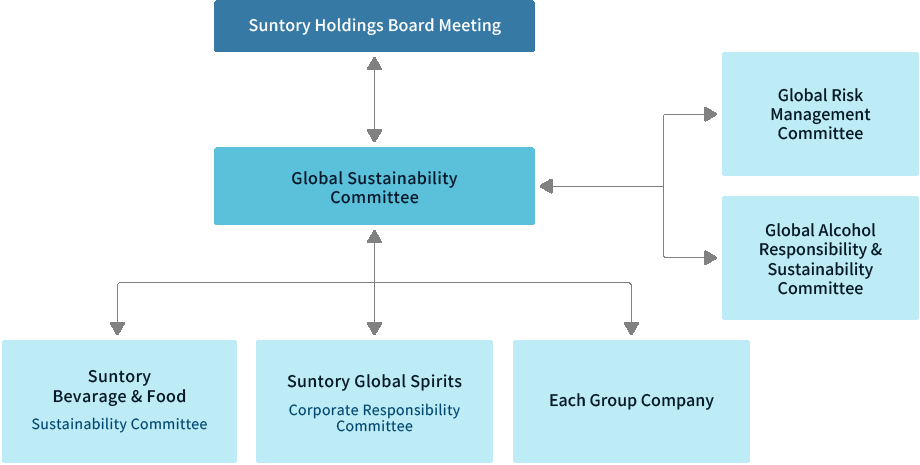
Global Sustainability Committee
The Global Sustainability Committee (GSC) is the core of our sustainability management promotion system. The committee is chaired by the Chief Sustainability Officer, with Executive Officers from each business serving as vice chairs. Committee members include the Directors in charge of each functional division, the heads of Group companies from around the world, and the heads of functional divisions.
The GSC discusses the Group’s sustainability strategies and confirms progress on priority themes (water, climate action, raw ingredients, containers and packaging, health and human rights). Progress on environmental and social activities as well as business risks and opportunities are reported to the Board of Directors on a quarterly basis. In addition, the Board of Directors is provided with the opportunities to hear advice from third party experts on sustainability management. Additionally, the targets used to determine executive compensation include a sustainability component.
Suntory Group's Environmental Management Promotion Structure
Environmental Policy Implementation Structure
To implement our Environmental Principles, each Group company appoints an environmental management officer, while designated personnel at each business site manage daily compliance and environmental performance. This includes strict internal standards for wastewater and air emissions. In the event of a serious environmental accident or regulatory violation, there is a system in place for immediate reporting to management. As of the end of 2025, we have had no major environmental incidents.
Environmental Management System (ISO14001)
We have also introduced ISO14001–based environmental management systems at our major production sites in Japan and overseas, checking through periodic internal audits and third-party certification. Suntory Group companies in Japan*1 have ISO integrated certification. Our small-scale sites have been exempt from certification since 2017 but instead have strengthened compliance management and transitioned to more efficient operations. Each business division works together under this structure to promote environmental considerations throughout the entire value chain.
- *1Group companies in compliance with Japan’s SOX Act.
Targets and Progress
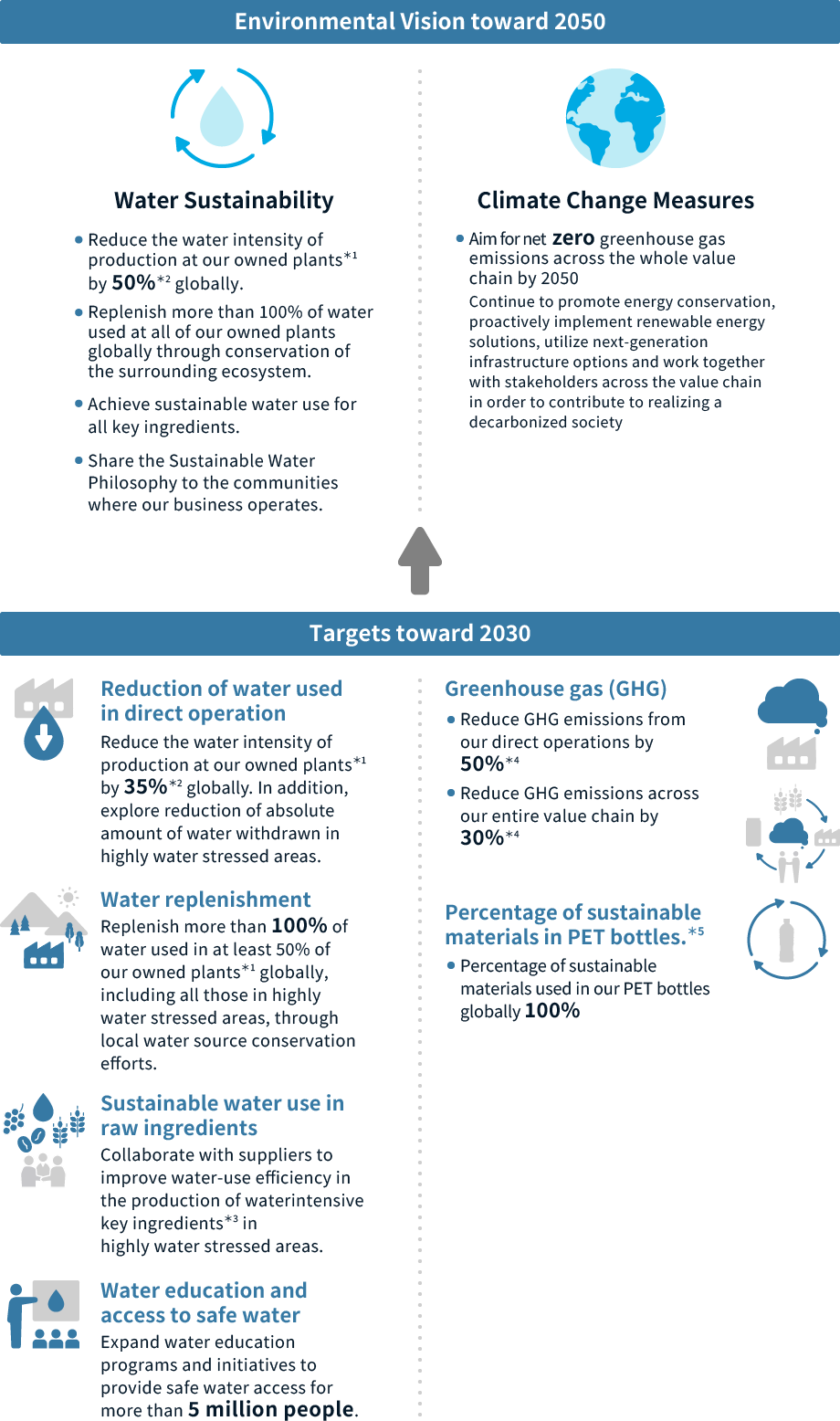
Suntory Group has established Environmental Targets toward 2030 in addition to our long-term Environmental Vision toward 2050, covering water and climate action, which are expected to have a particularly large impact on our business operations among sustainability issues. We have also set goals for containers and packaging toward 2030 and are currently taking action accordingly.
Mid- to Long-term Goals
-
*1Suntory Group plants that manufactures finished products.
-
*2Reduction per unit of production based on the business fields in 2015.
-
*3Coffee, barley, and grapes.
-
*4Based on emissions in 2019.
-
*5Percentage of sustainable materials (e.g., recycled or bio-based materials) in terms of PET bottle weight.
Progress
| Materiality | 2030 targets | 2025 results | |
|---|---|---|---|
Water |
Reduction of water used in direct operations |
Reduce the water intensity of production at our owned plants*1 by 35%*2 globally. In addition, explore reduction of absolute amount of water withdrawn in highly water stressed areas |
|
Water replenishment |
Replenish more than 100% of water used in at least 50% of our owned plants*1 globally, including all those in highly water stressed areas, through local water source conservation efforts. |
|
|
Sustainable water use in raw ingredients |
Collaborate with suppliers to improve water-use efficiency in the production of water-intensive key ingredients*3 in highly water stressed areas. |
|
|
Water education and access to safe water |
Expand water education programs and initiatives to provide safe water access for more than 5 million people. |
|
|
Climate Action |
Scope 1,2

|
Reduce GHG emissions from our direct operations by 50%*4 |
|
Scope 1,2,3

|
Reduce GHG emissions across our entire value chain by 30%*4 |
|
|
Containers and Packaging |
Use of sustainable materials in PET Bottles |
Make 100% of PET bottles with sustainable materials (globally) |
|
-
*1Suntory Group plants that manufactures finished products.
-
*2Reduction of water intensity of production based on 2015 baseline year.
-
*3Coffee beans, barley, and grapes.
-
*4Based on emissions in 2019.
-
*5Percentage of sustainable materials (e.g., recycled or bio-based materials) in terms of PET bottle weight.
Our Initiatives
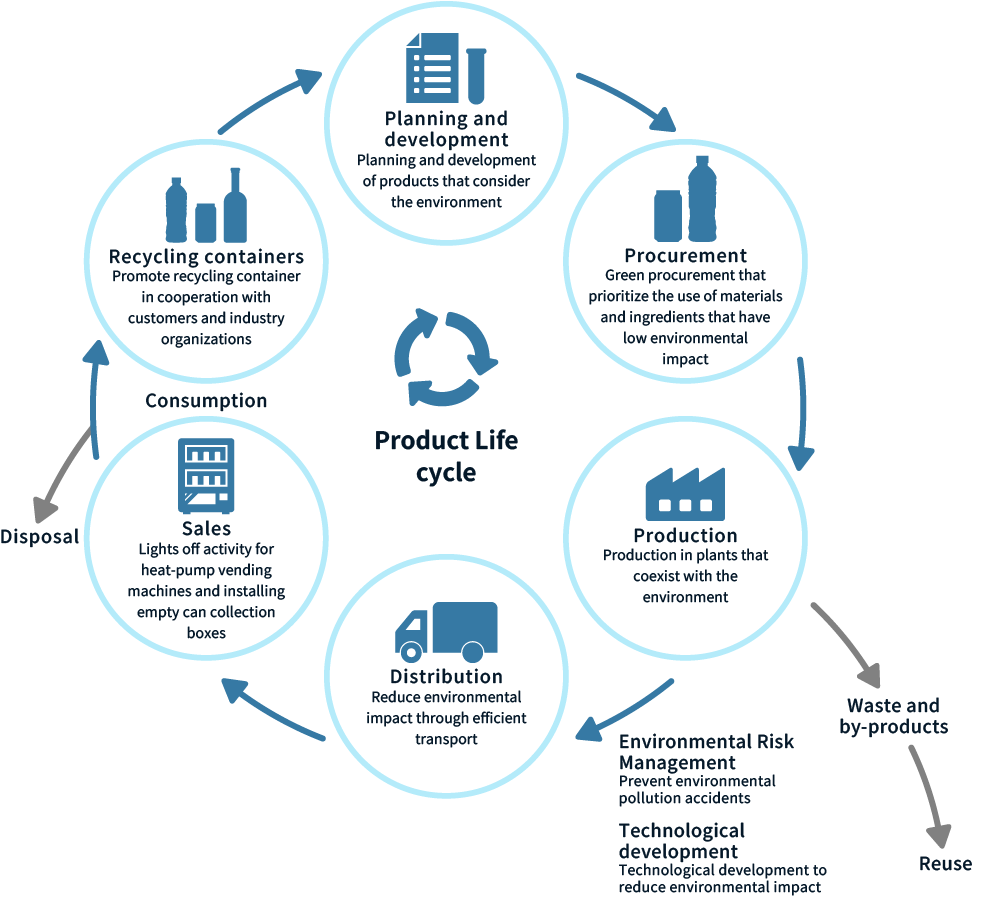
Reducing Environmental Impacts Across the Product Life Cycle
Suntory Group generates various by-products and waste from a wide range of business activities. We are committed to reducing environmental impacts by quantitatively understanding how we impact the environment throughout a product's life cycle — from planning and development to disposal and recycling.
In addition, following the global expansion of our business, we assess the environmental impacts of production sites around the world to understand our environmental impact it on a global scale. To reduce environmental impacts across the supply chain, we encourage our business partners, including suppliers who do business with Suntory Group, to disclose environmental information and take action to reduce their own environmental impacts.
This comprehensive approach has helped us achieve ongoing reductions in GHG emissions and water usage intensity for each of our products.
Compliance with Environmental Regulations and Voluntary Standards
In addition to complying with environmental laws and regulations (such as the Act on Promotion of Global Warming Countermeasures and the Energy Conservation Act in Japan), each Suntory Group plant is committed to environmental management by setting voluntary standards for wastewater treatment, boiler facilities and other environmental facilities that are equal to or more stringent than those set by laws and regulations.
In 2025, no serious accidents or violations affecting environmental pollution occurred.
Should a problem be found, we thoroughly investigate the cause and take measures to prevent a recurrence, sharing our findings with the entire Group.
Approach for Raising Internal Awareness
To deepen employees' environmental awareness and understanding of sustainability, and to develop capabilities to take proactive steps towards a sustainable society, Suntory Group is engaging in systematic awareness-raising activities.
In addition to conducting an annual sustainability awareness program to learn about the societal challenges facing our business and the initiatives we are undertaking, we are also expanding our digital learning programs and e-learning courses to Group employees worldwide. In Japan, we regularly hold specialized training sessions tailored to specific roles and job levels, such as seminars on environmental regulations for factory employees and LCA workshops for product development teams to help them acquire the skills required for each area of work.
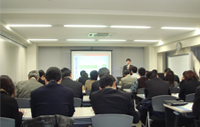
Seminar on managing Wastes Disposal and Public Cleansing Act
For more information on environmental training attendance, see Performance Data.
Firsthand Experience with Forestry at Suntory Natural Water Sanctuaries
We have been advancing employee forestry volunteer activities at our Suntory Natural Water Sanctuaries. Up until 2013, many employees and their families joined these activities as volunteers.
Since 2014, the program has evolved into a forest maintenance experience aimed at helping each employee personally understand and embody Suntory Group’s corporate philosophy. Approximately 13,000 employees in our alcoholic and non-alcoholic businesses have participated as of March 2026. This training is currently included in the onboarding program for new employees.
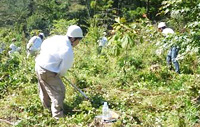
Forestry maintenance training for employees
Green Bonds
Suntory Group actively engages in sustainable finance to achieve a decarbonized society and reduce water consumption. Based on our 2022 Sustainable Finance Framework, Suntory Holdings Limited issued a green bond, a type of SDG bond, with proceeds to be used for projects that contribute to solving environmental issues.
