

Our Policies and Approach
Basic Policy on Sustainable Procurement
In order to offer our customers high-quality products and services, Suntory Group recognizes the importance of promoting sustainability throughout our entire supply chain. This means to give due consideration to the environment and society, as well as to safety and reliability.
In 2011, to promote sustainability in procurement, we established the Suntory Group Basic Policy on Sustainable Procurement consisting of 6 main pillars—legal compliance, human rights and labor standards, quality, environment, information security, and coexistence with society—that address global issues such as child labor, forced labor, freedom of association and collective bargaining, working hours, and the guarantee of minimum wages. To advance sustainability in collaboration with our business partners, we communicate with them to ensure awareness and seek their understanding.
To avoid our purchasing practices negatively effecting the human rights of our suppliers’ workers, we agree on estimated lead times with our suppliers and share our payment terms in advance. We also implement the necessary mechanisms and procedures so that payments are executed according to the timeframe agreed upon with the supplier.
Furthermore, if we identify high human rights risk in one particular ingredient, we review our purchasing practices and strive to reduce the risk. For example, in some of our business units we switch to sustainable-certified palm oil in order to minimize human rights and environmental risks.
Suntory Group has been working toward a target of zero deforestation across its key forest-risk commodities by the end of 2025. Through these efforts, we have identified challenges in the upstream supply chain, and to address them, we have begun verifying traceability back to the production origin using digital and other technologies, and building a new risk-assessment framework in collaboration with our suppliers. Going forward, we will use the results of this verification to roll out effective due diligence.
Suntory Group Basic Policy on Sustainable Procurement (Established in 2011)
In order to provide high-quality products and services safely and reliably based on our corporate philosophy and our Code of Business Ethics, Suntory Group engages in fair business practices and, in collaboration with supply chain business partners, promotes procurement activities that take social responsibility into consideration, mindful of such issues as human rights, labor standards, and the environment.
We build good partnerships with our business partners and contribute toward realizing a truly affluent and sustainable society.
-
1.Legal Compliance and Respect for International Standards of Conduct
We will promote fair and equitable procurement activities that comply with each country’s laws and respect international standards of conduct. -
2.Consideration for Human Rights, Labor, and Safety and Health
We will promote CSR initiatives in the supply chain that respect basic human rights and are mindful of labor conditions and safety and health. -
3.Guaranteeing Quality and Safety
Aligned with the Suntory Group Quality Policy, we will promote CSR initiatives in the supply chain that seek to guarantee a high level of quality and safety based on the optimal standards for quality, cost, and supply. -
4.Consideration for the Global Environment
Consistent with the Suntory Group Environmental Principles, we will promote procurement activities mindful of the global environment. -
5.Preservation of Information Security
We will strictly manage confidential information regarding procurement dealings and personal information. -
6.Coexistence with Society
We will promote social contribution initiatives directed toward coexisting within society.
Furthermore, as stated in our Human Rights Policy, we require our suppliers to understand and comply with the International Labour Organization (ILO) Tripartite Declaration of Principles concerning Multinational Enterprises and Social Policy and ILO Declaration on Fundamental Principles and Rights at Work. We expect compliance through the voluntary efforts of our suppliers, even if the ILO principles are not adequately protected by local law.
Partner Guidelines
We have established the Suntory Group Partner Guidelines to realize sustainable procurement throughout the value chain based on the Suntory Group Basic Policy on Sustainable Procurement, since we regard our suppliers and other business partners as sharing the same ethical values, respecting human rights, and seeking to protect the environment. These guidelines put in place the specific compliance items required in each field, from human rights and legal compliance to the environment, for Suntory Group suppliers and other business partners in Japan and overseas. These guidelines are to confirm that the same ethical values are shared between Suntory Group and our business partners. Compliance with our human rights commitments is a prerequisite for engaging in a business relationship with us, and we require both new and current partners to sign these guidelines. If severe human rights violations that contravene the law are discovered, and communication reveals a lack of willingness from the business partner to improve, this may lead to the termination of the contract. We are promoting joint efforts with suppliers for compliance, such as sharing the Partner Guidelines at guideline meetings or sharing related information through Sedex. In addition, in terms of human rights commitments, we request our partners to cascade down their own commitments to their suppliers.

Promoting Green Procurement
Green procurement is selecting items and services that consider the environment, such as by not including hazardous substances or using resources efficiently, when selecting ingredients, materials and equipment to purchase.
Suntory Group has established the Suntory Group Green Procurement Standard (revised in 2011) based on the Suntory Group Basic Policy on Sustainable Procurement and promotes procurement activities to lower environmental impacts in cooperation with each business partner.
Suntory Group Green Procurement Standard (revised in 2011)
-
1.Basic policy
Suntory Group strives to purchase ingredients, materials and services that have the lowest environmental impact as possible for items and services used in the Group to build a sustainable society.
-
2.Prioritized items
-
a)Consideration of not using environmentally polluting substances, etc.
-
b)Consideration of resource- and energy-saving through use of renewable resources, miniaturization, etc.
-
c)Consideration of resource collection that does not damage the ecosystem
-
d)Long-term use is possible through repair, parts replacement, etc.
-
e)Whether it is reusable
-
f)Whether it is designed to be recyclable
-
g)Whether it is easy to dispose or treat
-
h)Whether environmental information about the item is disclosed
-
i)Consideration of whether the item is manufactured or sold by a business operator that actively engages in environmental conservation such as acquiring ISO 14001
-
Promotion Structure
Global Sustainability Committee
Suntory Group has established a system for promoting environmental management centered on the Global Sustainability Committee (GSC). Under the supervision of the Chief Sustainability Officer, GSC formulates strategies related to the material issues outlined in the Suntory Group Sustainability Vision. GSC also oversees the progress of these strategies and analyzes the business risks and growth opportunities, reporting to the Board of Directors on a quarterly basis.
For more information on the Global Sustainability Committee, see Environmental Management.
Our Initiatives
Supply Chain-related Human Rights Due Diligence
Suntory Group has established the Basic Policy on Sustainable Procurement, and in collaboration with our business partners, promotes initiatives to respect human rights throughout the supply chain.
In 2019, we joined Sedex, the world’s largest ethical information sharing platform for suppliers. We request that our suppliers join Sedex and share information, including participation in SAQs*, to enable us to identify issues, if any.
-
*Self-Assessment Questionnaires
For more information on supply chain risk assessment, see Respect for Human Rights.
Activities for Stable Procurement of Raw Ingredients
With regard to agricultural products and other raw ingredients that are essential to our products, we cooperate with business partners across the supply chain, identify social and environmental issues, and promote sustainability initiatives that enable us to grow together, thereby enriching our communities. It is predicted that extreme weather, such as drought and flooding, occurring due to the rise in the Earth’s average temperature caused by climate change will have a major impact on production activities, including fluctuations in production volumes, creating the need to move to other locations which offer suitable cultivation. Furthermore, with the increasing globalization of corporate activities, demand for the right responses to social issues is growing, which includes consideration for the human rights of people working in the supply chain.
To offer our customers high-quality products and services, at Suntory Group we believe it is crucial to promote sustainability throughout our entire supply chain. This means we need to give due consideration to the environment and society, as well as to safety and reliability.
Based on this belief, Suntory Group is formulating a long-term strategy and promoting activities for optimum and sustainable procurement throughout the Group.
Overview of Long-term Strategy
We utilize the TCFD framework to formulate this strategy and we also referred to open scenarios from RCP2.6 (scenarios below 2℃), RCP8.5 (4℃ scenario) from the Intergovernmental Panel on Climate Change (IPCC) and the International Energy Agency (IEA) for identifying risks and opportunities. The documents, information, and data referred to in this exercise are current as of the time of the review, and the analyses and calculations based on them are subject to uncertainty.
By focusing on our policies such as Environmental Vision toward 2050 and the Suntory Group Basic Policy on Sustainable Procurement, in addition to long-term trends specific to our raw ingredients, we aim to create a vision of what we would like raw ingredient procurement to be in the future, find countermeasures based on the gaps between the current situation and be ready to respond to a wider range of social and environmental sustainability issues.
Activity Overview
Strategy development is based on the following steps:
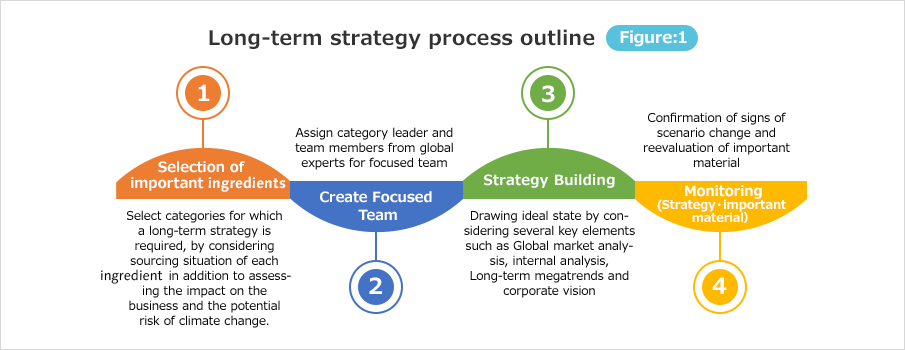
1. Selection of Key Raw ingredients
- Identify ingredients that are particularly important for our business activities
- Based on the results of assessments, select the ingredients category for which long-term strategies are to be formulated through consultations with related parties
Risk assessment process
-
1)Extraction of key raw ingredients
The impact is defined as the loss of product sales that the business would suffer if there were a problem with the supply of raw ingredients, and raw ingredients with a high impact extracted as key raw ingredients, including agricultural products such as barley and corn, undergo a certain processing such as sugar, vitamin C, and oak wood. -
2)Risk assessment
To evaluate the possibility of problems in the supply of the extracted key raw ingredients, the effects of climate change on yield and suitable areas for cultivation, which are considered to have the greatest impact on future supply, were studied and evaluated from research and statistical perspectives. One of the results is shown in Figure 2. For raw ingredients that undergo a certain amount of processing, the risk assessment considers the impact of climate change on the production area of the base ingredient and the ratio of raw ingredients used in the process. (Example: for sugar, see the results of climate change impact assessment for sugarcane and sugar beets.)
Based on the above approach, we found that the yields of agricultural raw ingredients such as barley and corn used in both alcoholic beverages and non-alcoholic beverages, oak and hops used in the alcoholic beverage business, and coffee beans used in non-alcoholic beverages, will be significantly impacted in several production areas.
Figure 2: Results of Climate Change Impact Study
4℃ temperature increases scenario in 2050: Study of the effects of yield and suitable land on key raw ingredients and production area
| Business Sector |
Raw Ingredients | North America |
Latin America |
Asia | Europe/Africa | Oceania |
|---|---|---|---|---|---|---|
| Alcoholic and non-alcoholic beverage |
Barley* | Canada Yield:  |
UK Yield: France Yield: |
|||
| Alcoholic and non-alcoholic beverage |
Corn* | USA Yield:  |
Brazil Yield: |
China Yield: |
||
| Alcoholic and non-alcoholic beverage |
Sugarcane* | Brazil Yield:  |
Thailand Yield:  |
Australia Yield: |
||
| Alcoholic beverage |
Oak | USA Wood quantity: |
Japan Suitable land:  |
Spain Suitable land: |
||
| Alcoholic beverage |
Hop | USA Yield: |
Germany Yield: Czech Republic Yield: |
|||
| Non-alcoholic beverage |
Coffee beans | Brazil Yield: Colombia Yield: Guatemala Yield: |

-
*Includes origin of processed ingredient.
-
3)Formulation of action plan
Based on the results of the survey, we consulted with the relevant departments and selected the following raw ingredient commodities (see figure below), for which we are advancing activities.
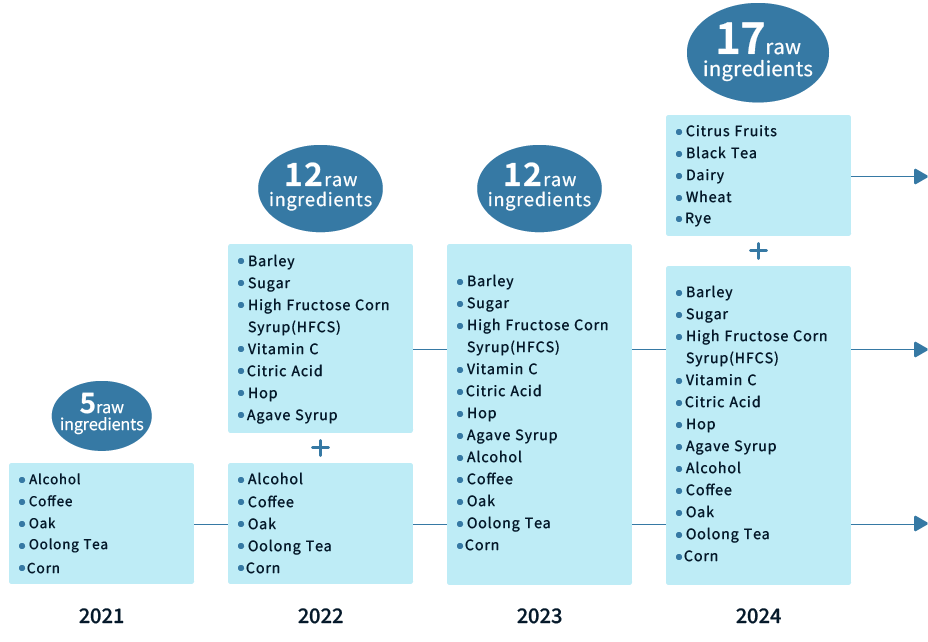
-
Note)Coffee refers to the results of a climate change impact study on coffee beans. Similarly, sugar refers to sugarcane, etc. HFCS, vitamin C, and citric acid refer to the results of a climate change impact study on corn.
2. Creation of Focused Teams
- A taskforce consisting of experts within Suntory Group from various departments such as research, development, procurement, and quality assurance is formed to work on the selected ingredients
3. Building Strategy
- Analysis of market, company, and trends by a team of experts
- Analysis of future world scenarios and description of the ideal state within those scenarios
- Design of activities by backcasting from the future world back to the present to set issues
The task force set its time horizon axis to 2050 with respect to the relevant raw ingredient categories, and considered publicly available scenarios from the IPCC, IEA, and other organizations. It then considered possible business impacts as of 2050 from an environmental perspective, including the impact of climate change, as well as from a social perspective, including human rights.
By the end of 2024, we completed the long-term strategic planning for the 17 raw ingredient categories as outlined in our roadmap. Strategy-driven actions include participating in joint research on regenerative agriculture and disease control.
For key raw ingredients, the total business impact of the 4℃ scenario as of 2050 is projected to be 8.0 billion yen (Figure 3). Prices of coffee, oolong tea, corn, and barley are projected to rise due to falling output, raising procurement costs. At the same time, sugarcane and sugar beet prices are projected to decrease on higher output, resulting in a positive business impact.
(Figure 3) Impact on Business
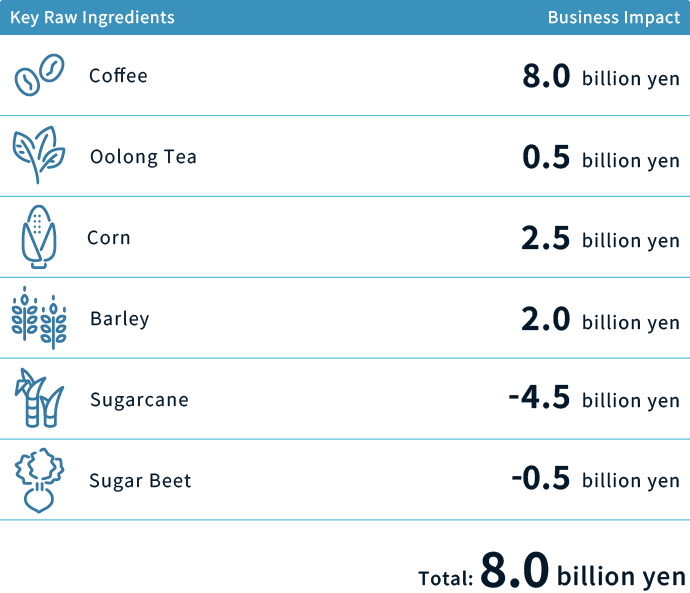
-
*Scope: Suntory Global Spirits Inc., Suntory Beverage & Food Limited, and Suntory Spirits Ltd.
-
*Currency exchange rate 1 USD = 147 JPY
-
*For corn, calculations included alcoholic beverage and food use, including processed raw ingredients.
-
*For barley, calculations were made for alcoholic beverage use only.
4. Strategy Monitoring
- Monitoring of signs of scenario change and strategy revision based on prior assumption of change
- Analysis of future world scenarios and description of the ideal state within those scenarios
- Revising road map of strategy building by reevaluating ingredients risk
Strategy Execution
The long-term strategy formulated by the team of experts is discussed with each operating company to promote activities. GSC, which is an advisory body to the Board of Directors, also discusses the strategy.
Learnings and Actions from the Long-Term Strategy
Example of Activities Derived from Specific Strategies
Addressing human rights issues such as forced labor and child labor, as well as environmental issues including reducing greenhouse gas (GHG) emissions from agriculture, restoring soil biodiversity, and effectively using water, is becoming increasingly important upstream in the supply chain.
Suntory Group engages in a range of initiatives within our supply chain, in collaboration with production areas, to realize sustainable agriculture.
1. Participation in Sustainable Agriculture Initiatives
We are further promoting sustainable raw ingredient procurement by undertaking such initiatives as building networks, and engaging in collaboration, with companies and private organizations that are leaders in sustainable agriculture.
(1) Sustainable Agriculture Initiative (SAI) Platform
Recognizing the need for enhanced sustainability of agricultural raw ingredients cultivation, Suntory Group became the first Japanese company to join the Sustainable Agriculture Initiative Platform, an international organization launched in 2002.
For more information, see Suntory Group Joins the Sustainable Agriculture Initiative (SAI) Platform.
(2) VIVE
We are a member of VIVE, an international organization supporting sustainable procurement of agricultural products, mainly sugarcane, based on our sugar strategy. We were the first Japanese company to join this organization.
(3) Biodiversify
Suntory Group has, for the first time as a Japanese company, entered into a partnership with Biodiversify, a natural capital consulting firm, and has begun efforts to develop agricultural strategies and a roadmap for sustainable sourcing of raw ingredients.
2. Sustainable Sugar Procurement Initiatives
We are implementing the following 12 initiatives for sustainable agriculture in our supply chain.
Next Steps
Based on the formulated strategy, we will consider and promote initiatives for regenerative agriculture, which is expected to have mitigation and adaptation effects for raw ingredients with high climate change risk or raw ingredients with high GHG emission risk in the future.
In strategy monitoring, we will periodically check for the occurrence of events such as the junctures of multiple possible scenarios and the success of technological innovations necessary to achieve the desired goals. This will enable us to capture important changes as much as possible in advance and revise the strategy to incorporate them.
We will also revise the road map for strategy building by regularly reevaluating risks.
Collaboration with Suppliers
Suntory Group is promoting pioneering initiatives in collaboration with diverse partners to reduce GHG emissions and address environmental and social challenges, such as human rights, throughout the value chain.
Initiative to Procure Malting Barley Produced through Regenerative Agriculture
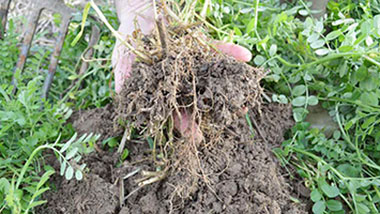
To reduce GHG emissions originating in raw ingredients, Suntory Group is collaborating with malt supplier Muntons, agricultural consulting firm Future Food Solutions, and barley farmers, and implementing a range of initiatives in a project to procure barley for malting produced through regenerative agriculture*1 in the United Kingdom.
Through agricultural approaches such as the use of cover crops*2 and no-till farming, the project hopes to reduce GHG emissions from agriculture by 50% within 5 years compared to conventional approaches, while regenerating soil biodiversity, enhancing soil fertility, reducing chemical fertilizer and pesticide use, and using water more effectively.
-
*1Agricultural methods that focus on enhancing soil fertility by regenerating its ecosystem to make crop production sustainable.
-
*2Cover crops that can enhance soil fertility by supplying organic matter to the soil, preventing erosion, etc.
Collaboration with Green Tea Production Area
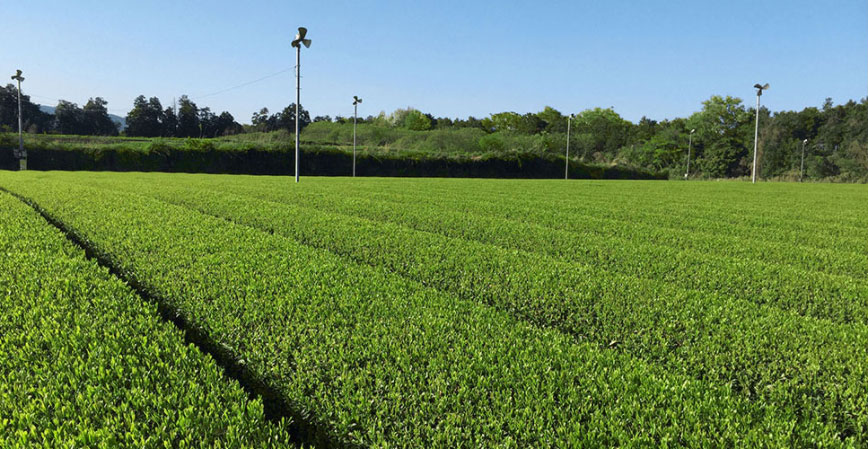
In order to promote the sustainable procurement of tea leaves used for green tea beverages, Suntory Group has launched a long-term initiative in collaboration with a tea production area.
Collaborating with Kuma Regional Agricultural Cooperative (JA Kuma), we have succeeded in reducing GHG emissions by more than 30%*compared to the conventional method by introducing a nature-positive process in the tea leaf production process at JA Kuma.
We will continue to pursue high-quality tea production and contribute to the continuation of tea production in the region and the training of successors in tea farming.
-
*Emissions per unit production weight in the production of green tea raw ingredients in the process from leaves to Aracha tea.
Supporting Sustainable Agriculture of Blackcurrant Farmers
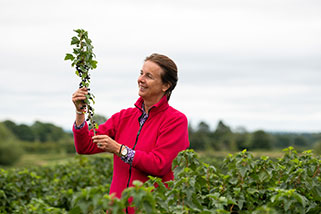
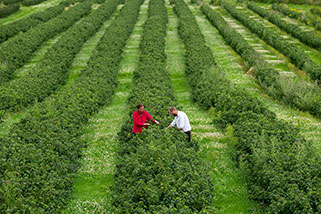
Suntory Beverage & Food Great Britain and Ireland (SBF GB&I) manufactures and sells Ribena, a soft drink loved by many in Europe and other regions. Some 90% of the blackcurrants grown in the UK are used by this iconic juice drink brand. SBF GB&I began supporting sustainable agriculture of blackcurrant farmers in the UK from 2004. SBF GB&I employs agronomists that directly advise farmers and design biodiversity plans according to the biological habitat of each farm and surrounding area to protect the ecosystem of rivers and wetlands.
We also conduct research on new species of blackcurrant that are resilient to climate change. Ben Lawers, a new variety of blackcurrant that is more resilient to climate change, was harvested in 2020. This success was the result of a long-term joint research with the James Hutton Institute, a research institute for agriculture.
Promoting Sustainable Procurement in Upstream Supply Chain for Coffee
Guatemala
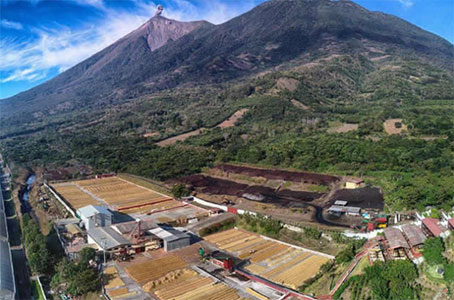
Suntory Group is supporting Guatemala coffee export company UNEX in promoting their “farmer aid” program aimed at helping coffee farmers tackle different environmental and social challenges and strengthen the sustainability of the coffee beans they produce. The program is based on 4 pillars: health, education, sustainability, and climate change. In 2022, Suntory Group financially supported this program in 2 ways:

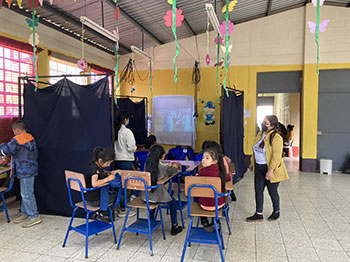
(1) Childcare Center in Alotenango
This childcare center is open during school holidays (from October to January) and is used as a free education and recreation place for coffee farmer’s children. It serves the dual purpose of minimizing the risk of child labor by taking care of the children during harvesting season. The center also provides medical services to both children and their parents.
(2) Coffee Farmer Training in Santa Barbara
We are supporting the current sustainable practices of the farm via training, which benefits small producers to strengthen their coffee production and improve their families livelihood. We also empower women through farming practice training in order to contribute to a better livelihood for them and their families. Through the farmer aid sponsorship, we are able to create positive impact on approximately 300 families, including children, in Guatemala.
Brazil
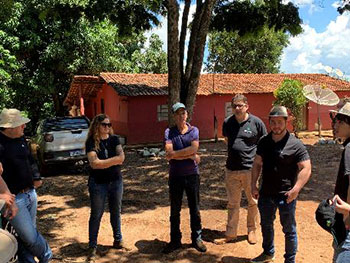
In order to expand our human rights due diligence efforts to upper tiers of our supply chain, we are formalizing a partnership with ITOCHU and their local partner in Brazil, Sucafina, to start a pilot program to assess and support coffee farmers in the Cerrado region of Brazil.
The pilot leverages Sucafina’s responsible sourcing program, IMPACT, and is founded on 5 main pillars: carbon emissions, deforestation, human rights, living income, and regenerative agriculture. IMPACT standard verification ensures compliance with 80 social, environmental, and economic standards modelled on the Global Coffee Platform’s Coffee Sustainability Reference Code, with independent audits done every 3 years. Regarding human rights, IMPACT has key indicators such as health and wellbeing, forced labor, child labor, freedom of association, grievance, working hours, discrimination and land rights. Going forward, we will monitor and improve the working conditions of the targeted farms during the initial 3 years of this pilot.

Uganda
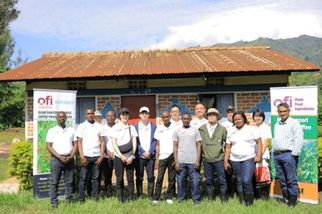
To promote environmental (GHG reduction, etc.) and human rights due diligence activities for coffee farmers in Africa, Suntory Group participated in a pilot program to evaluate and support coffee farmers in Uganda. The program, which included an examination of local conditions, was conducted by MC Agri Alliance and Olam, a Singapore-based general agricultural trading company.
This pilot program utilizes Olam’s AtSource sustainable procurement program to evaluate and support farmer activities to give farming guidance for enhanced livelihoods, plant trees to reduce GHG emissions and prevent deforestation, provide guidance on efficient fuel use, and improve farmers’ livelihood infrastructure.
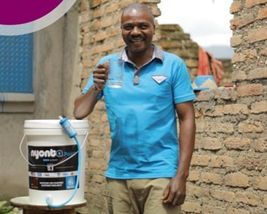
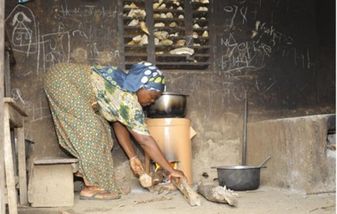
Farmers targeted by the program have virtually no gas, electricity, or water supply infrastructure, living instead by storing rainwater and burning wood. The project is providing infrastructure to support farmers’ livelihood income through agricultural guidance on how to plant crops in addition to coffee that are self-sufficient and have high cash value, including bananas, soybeans, cotton, sesame, and corn, as well as improving the sanitary conditions for rainwater by installing water purification filters in order to provide safe water. Moreover, the labor involved in making firewood and cooking is not only a significant burden for women but also leads to GHG emissions and deforestation. As a measure to mitigate these impacts, we provide cooking stoves. We also conducted interviews regarding educational and medical structures for children, who make up the majority of farmers. We were able to verify that, while such school infrastructure as classrooms with desks and chairs is progressively improving, some schools lack textbooks and computers, and efforts to expand medical facilities face challenges.
AtSource conducts third-party audits to evaluate support initiatives and their effectiveness. This ongoing monitoring makes possible continuous initiatives to help target farmers.
Engagement with Local Coffee Farm to Improve Community Resilience
Suntory Group procures a portion of its coffee beans, from Fazenda Bau, which is a specialty coffee farm in Minas Gerais, Brazil, as we aim for the highest quality and sustainable supply of coffee beans. Fazenda Bau has acquired international sustainable certifications, and their thorough quality management and workplace environment are highly praised.
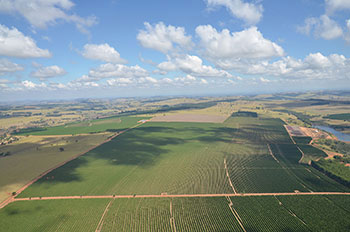
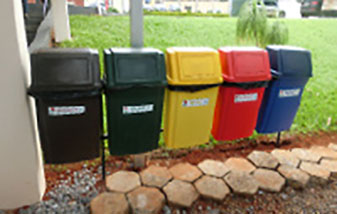
Fazenda Bau has been engaging in a wide range of activities to promote sustainability, turning their attention to labor practices and the labor environment, conducting efforts such as courses on the health and safety of employees, as well as courses about motivation and human relationships in the workplace, among other initiatives. Environmental conservation activities such as separating trash and comprehensive management of the water intake as well as tree planting initiatives show their awareness regarding their impact on the environment. In addition, Fazenda Bau has been engaging in a support project at a neighboring school since 2011 with the purpose of contributing to the local community.


Joint Research for Controlling Orange Diseases
Suntory Group is participating in a joint research by France’s CIRAD on controlling orange diseases, with a focus on citrus greening disease, considered to be one factor in declining orange yields.
Citrus greening is a bacterial disease that infects citrus fruits such as oranges. It causes a deterioration in fruit quality, including shape and taste. Orange harvests have been steadily declining in recent years, with citrus greening disease said to be one of the reasons. This joint research is taking place over a six-year period from 2024 and involves developing and cultivating orange varieties with improved resistance to citrus greening disease. Verification of adaptability will be done sequentially in Spain, Brazil, and other countries.
Supplier Engagement and Educational Activities
Suntory Group strives to promote sustainable procurement together with all of its business partners in the supply chain. In addition to providing education to our employees, we hold annual policy briefings for our major business partners, such as raw materials suppliers, contract manufacturers, and logistics partners. We are promoting better awareness and support for sustainability initiatives within each company or in cooperation with Suntory Group by introducing Suntory Group initiatives and providing questionnaires.
Collaboration with Logistics Partners
The Safety Promotion Committee, launched in collaboration with our logistics partners, promotes initiatives to ensure safety, environmental friendliness, and risk management. A safety promotion convention is held each year for those across Japan involved in transportation and delivery. The convention provides thorough safety education via study sessions and contests along with information sharing through outstanding case studies. Awards are presented to outstanding drivers and operation bases to raise awareness of the safety management system.
We are also working to strengthen our transportation and delivery safety management system by promoting the acquisition of G Mark Ccertification, which certifies business locations that have achieved safety excellence and reliability. This certification system is operated by Japan’s Ministry of Land, Infrastructure, Transport and Tourism (MLIT).
Industry Collaboration Initiatives
Suntory Group participates in The Consumer Goods Forum Japan*, which promotes distribution networks of consumer goods across the industry, to reduce the environmental impact of the Suntory supply chain.
-
*The Consumer Goods Forum Japan is an organization primarily made up of companies in the consumer goods distribution industry that engages in cooperative manufacturing, distribution and sales efforts to address common challenges in non-competitive industries in Japan.
Rigorously Engaging in Fair and Equitable Business Practices with Business Partners
In our dealings with business partners, we provide each company with an opportunity for equitable competition in keeping with our Purchasing Control Regulations and our Business Partner Selection Standards, based on the Suntory Group Basic Policy on Sustainable Procurement. At the same time, we fairly evaluate efforts regarding the quality and supply capabilities of the products and services, financial status, assured safety, environmental conservation, and social contribution of each company, when we select new suppliers or determine whether to continue business with our existing business partners.
By joining forces with our business partners as mutually reliable partners, we aim to provide products and services that delight our customers.
