
Our Policies and Approach
Water is a vital resource that supports human life and livelihoods, and the foundation of Suntory Group’s business activities. While water is a renewable resource that will never disappear from Earth, only about 0.01% of the planet’s water is freshwater accessible to humans.
On the other hand, global issues concerning water resources have arisen due to factors such as population growth, economic development in developing countries, and climate change. It is predicted that by 2050, approximately 5 billion people worldwide will face severe water shortages*. This worldwide water scarcity is intertwined with numerous issues, as water is used not only for drinking and domestic purposes but also extensively in food production.
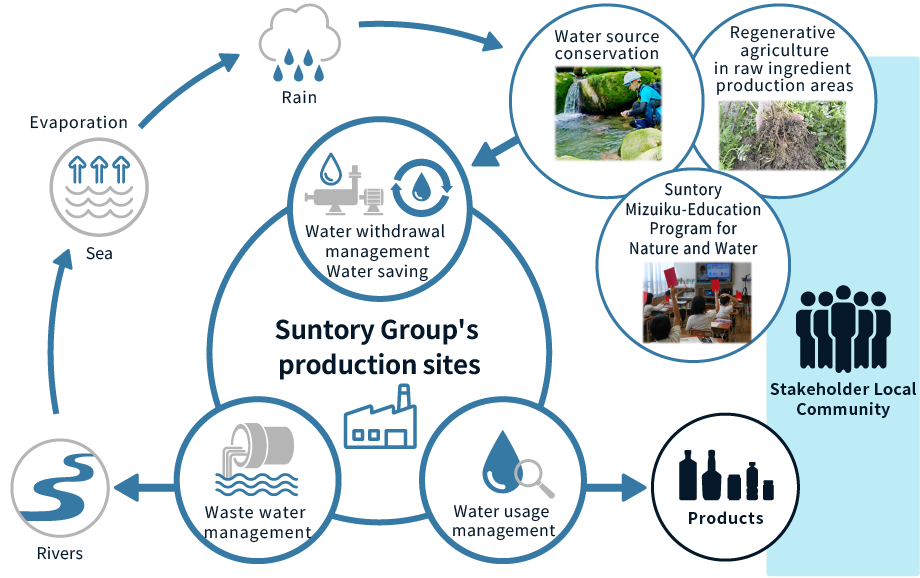
At the top of Suntory Group Environmental Principles is “achieving water security.” We are advancing various initiatives to contribution to the healthy circulation of water in nature, with a view that encompasses the entire value chain.
-
*World Meteorological Organization (WMO) “The State of Climate Services 2021”
Suntory Group Sustainable Water Philosophy
As a multinational corporation that depends on and benefits from water, Suntory Group must earnestly address worldwide challenges and contribute to building a sustainable society.
Based on the Suntory Group Environmental Principles , we have established the Suntory Group Sustainable Water Philosophy to guide our efforts in addressing water challenges in various regions around the world. Based on this philosophy, we develop and promote initiatives that are tailored to the water resources conditions in each area where we do operate.
Suntory Group Sustainable Water Philosophy (Established in January 2017)
Water is the most important ingredient of our products, as well as a precious shared resource. In pursuit of “achieving water security,” which is at the top of Suntory Group Environmental Principles, we share the following philosophy across the Group to meet stakeholder expectations.
-
1.Understanding the natural cycle of water
We investigate watersheds around our sites to understand the local hydrological cycle, using a scientific approach when needed. -
2.Promoting environmentally conscious water use
We reduce the environmental impacts of water use on the natural water cycle by implementing 3R activities and returning water to nature after adequate treatment. -
3.Conserving watersheds
We conserve our watersheds and endeavor to improve local water quality and quantity in cooperation with stakeholders for a sustainable future. -
4.Engaging with the local community
We endeavor to support our community by fostering collective actions to solve water issues and enrich society.
Promotion Structure
Global Sustainability Committee
At Suntory Group, we have established a system to promote environmental management centered around the Global Sustainability Committee (GSC). Under the supervision of the Chief Sustainability Officer, GSC formulates strategies related to the material issues outlined in the Suntory Group Sustainability Vision. GSC also oversees the progress of these strategies and analyzes the business risks and growth opportunities, reporting to the Board of Directors on a quarterly basis.
For more information on the Global Sustainability Committee, see Environmental Management.
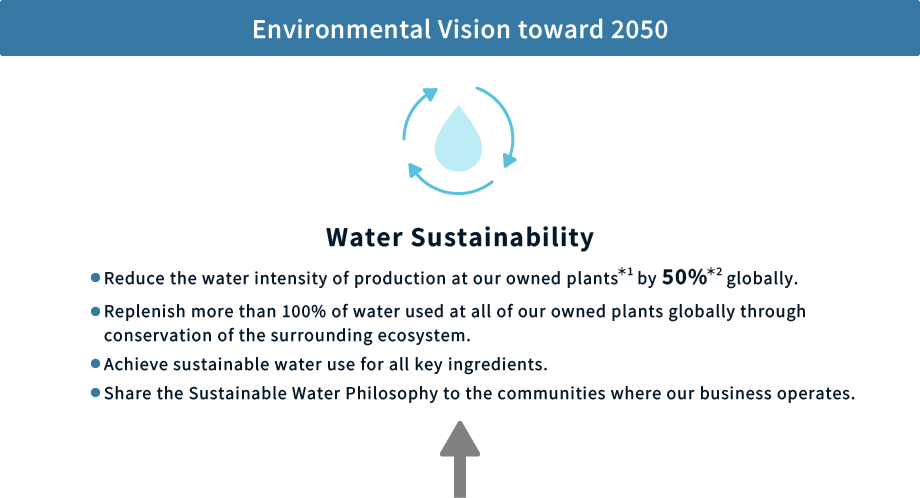
Targets and Progress
| Theme | Environmental Targets toward 2030 | 2025 Results |
|---|---|---|
|
Reduction of water used in direct operations
|
Reduce the water intensity of production at our owned plants by 35%*1 globally. |
Initiatives to Reduce the Amount of Water Used in Direct Operation |
|
Water replenishment
|
Replenish more than 100% of water used in at least 50% of our owned plants*2 globally, |
|
|
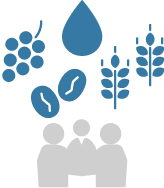
Sustainable water use in raw ingredients
|
Collaborate with suppliers to improve water-use efficiency in the production of water-intensive key ingredients*3 in highly water stressed areas |
|
|
Water education and access to safe water
|
Expand water education programs and initiatives to provide safe water access for more than 5 million people |
|


-
*1Reduction of water intensity of production based on 2015 baseline year.
-
*2Suntory Group plants that manufacture finished products: 27 plants in Japan, 52 plants overseas.
-
*3Coffee, barley, and grapes
For more information on water-related achievements, see the List of Performance Data.
Our Initiatives
Water Risk Assessment
Prioritizing the achievement of water sustainability within the Suntory Group Environmental Principles,” Suntory Group established the Suntory Institute for Water Science in 2003, and continuously conducts various assessments related to water. With a focus on sustainable business activities, we conducted risk assessment of water sustainability at our directly owned and operated sites. We also consider water risk assessment when developing new businesses.
Initiatives to Reduce the Amount of Water Used in Direct Operations
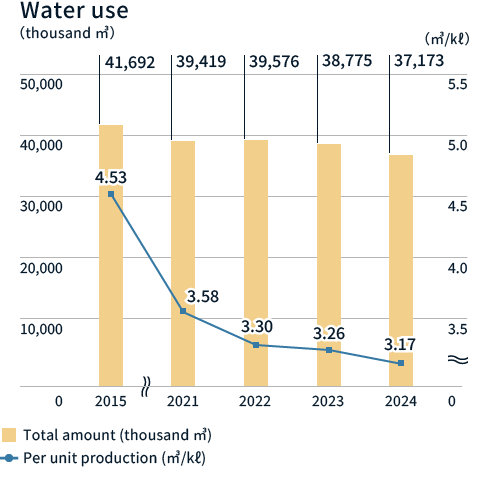
Trends in Water Withdrawal and Water Intensity of Production (Whole Group)
-
*Per unit production is the amount of usage per kiloliter produced.
Efficient Use of Water Resources
In Suntory Group’s plants, water is used not only as an ingredient but also for cleaning and cooling manufacturing equipment. To conserve limited water resources, we implement the “3Rs of Water”: reducing consumption (Reduce), using water repeatedly (Reuse), and treating it for repeated usage (Recycle). These efforts support our goal to reduce water consumption at our owned plants worldwide by 35%*.
At the Suntory Minami Alps Hakushu Water Plant, we conduct a variety of initiatives under the 3R framework. Notably, through advanced cascade (multi-stage) water recycling, we have achieved industry-leading levels in water use efficiency per production unit. In February 2025, the Plant received the highest “Platinum” certification from the Alliance for Water Stewardship (AWS).
-
*Reduction water intensity based on the business fields in 2015.
-
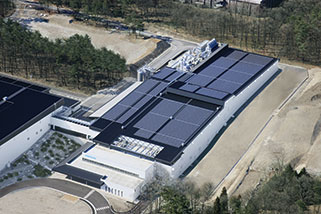
The Suntory Minami Alps Hakushu Water Plant
-
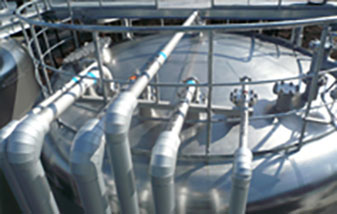
Reuse of water recycled at each stage of
cleaning stored in 200-ton tanks
For more information, see Achieving the AWS Certification for Water Stewardship.
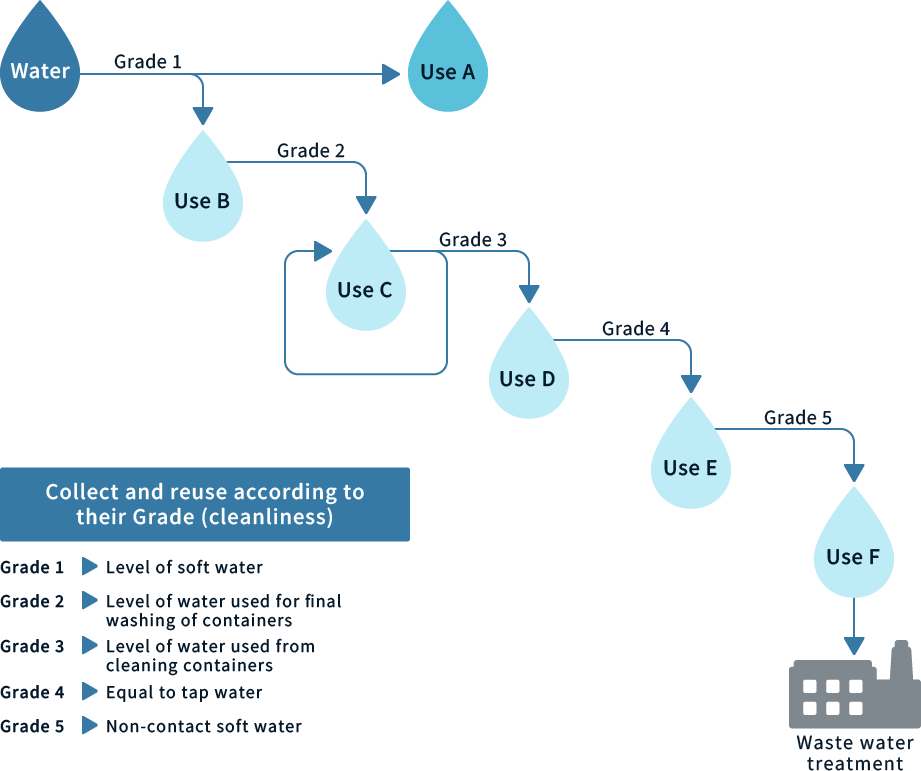
Water Cascade Recycling Process
This technology involves classifying the water used in the manufacturing process (groundwater, river and lake water, rainwater, tap water, and externally supplied water [recycled water]) into five grades based on cleanliness such as cooling and cleaning. The water is then progressively reused from applications requiring higher grades to those that can be satisfied with lower grades.
Strict Wastewater Management
Suntory Group established voluntary standards for wastewater that are equal to or stricter than the legal requirements to ensure that wastewater is returned to nature in a state as close to natural as possible. Wastewater from our plants is first purified using anaerobic wastewater treatment facilities* and other equipment before it is released into sewerage systems or rivers. To maintain these standards, we conduct continuous monitoring with measuring devices and daily water quality inspections by personnel.
-
*A treatment method that decomposes pollutants using microbes (anaerobic bacteria).
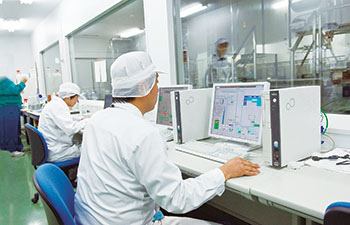
24-hour wastewater management system
Initiatives at the Water Source
Suntory Natural Water Sanctuary Initiative (Water Resource Cultivation/Restoring Biodiversity)
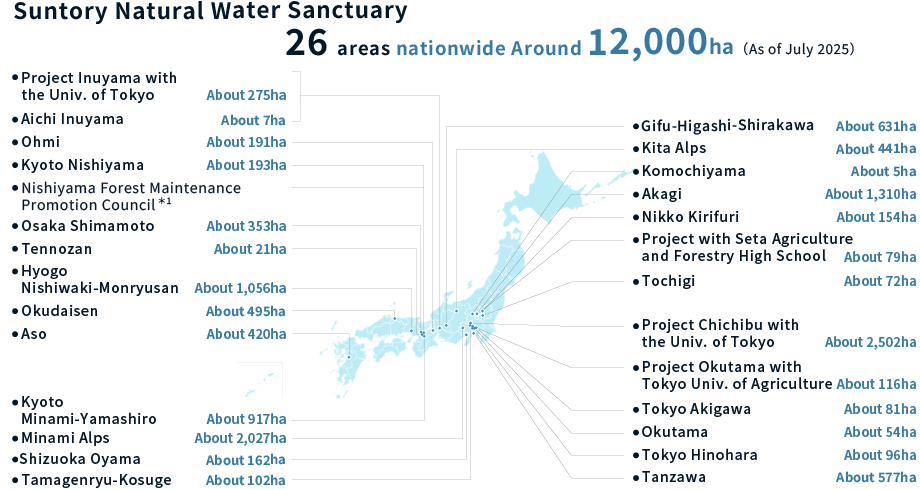
In 2003, Suntory Group launched the Natural Water Sanctuary Initiative aimed at enhancing water source recharge capabilities and preserving biodiversity. The initiative has now expanded to over 12,000 hectares in 27 locations in 16 prefectures across Japan, and is replenishing twice the volume of groundwater extracted by our owned plants in Japan. As we advance these efforts, we collaborate with leading researchers from various fields to ensure that our activities are scientifically grounded and sustainable for the next 100 years and beyond.
-
*1In Nagaokakyo, Kyoto, we are a member of the Nishiyama Forest Maintenance Promotion Council and we are cooperating in local forest preservation activities with people in the community. The area of the forests subject to this activity is not counted as part of our total Natural Water Sanctuary area.
Water Initiatives Worldwide
Suntory Group practices coexistence with nature in all regions where we conduct business worldwide. We will continue to engage in various initiatives as we strive to be a global leader in water sustainability.
United States of America
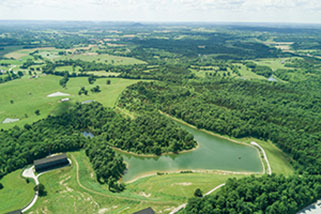
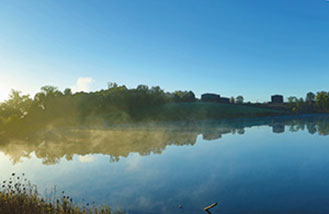
To protect the precious natural resource of water, we have been actively involved in conserving water sources around our bourbon distilleries and enhancing the biodiversity of forests. Established in 2016, the Natural Water Sanctuary at Maker’s Mark’s Star Hill Farm in Kentucky protects the full 35-hectare watershed of Bourbon Lake. Stewardship efforts focus on regenerating native trees and shrubs, converting lawns and pastures to pollinator-friendly plants, and targeted water-quality initiatives. This has reduced sediment entering Bourbon Lake by nearly one metric ton annually, increased water flow by more than 363m³, and enabled forests to sequester 7.0 tCO2e annually, while enhancing habit for amphibians, reptiles, birds and mammals, reinforcing our commitment to water protection and biodiversity stewardship.
In 2018, we set up a Natural Water Sanctuary within the 6,300 hectares of Bernheim Arboretum and Research Forest, the water source for the Jim Beam Distillery, and initiated additional environmental conservation efforts, which still continue today. These include like restoring the watershed, especially within Long Lick Creek and Wilson Creek, protecting habitats like the Lotus Wildlife Corridor and its headwaters, enhancing biodiversity with volunteer programs like the Beaver Brigade and a strong community education program that impacts more than 10,000 visitors per year.
Mexico
In collaboration with major tequila brand manufacturers and other leading companies, we launched a watershed stewardship project, a socio-environmental and multidimensional project to implement from 2020 to 2028. Charco Bendito project works on the restoration of the Cajititlán micro-basin, which belongs to the Santiago-Guadalajara River Basin. The project brings meaningful environmental and community benefits through wetland restoration, reforestation of over 250 hectares, and an educational and scientific program. The results include restored habitats fostering increased biodiversity, improved household water quality for local communities and an expected volumetric water benefit of over 300,000 cubic meters annually, enhancing aquifer recharge and water security in a water-stressed region.
Scotland
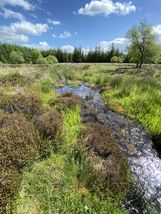
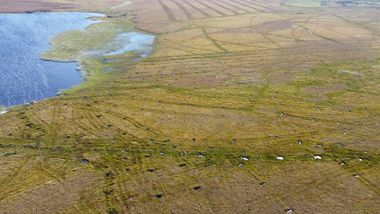
We launched the Peatland Water Sanctuary initiative in Scotland in 2021 to help protect and restore peatlands and water sources that are essential to whisky-making. By 2030, we will invest more than 4 million US dollars to restore 1,300 hectares of peatland. Looking ahead to 2040, we aim to restore peatlands on a scale capable of generating twice the amount of peat used by Suntory Group for whisky production. Through this initiative, we will contribute to sustainable whisky-making, while also delivering environmental benefits, including enhanced water retention, biodiversity conservation, and improved carbon storage.
France
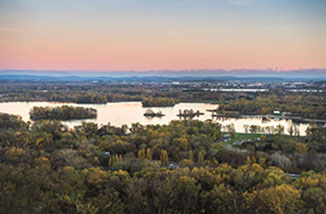
In France, we established a 20-year partnership for the conservation of water resources in 2017 with Grand Parc Miribel Jonage, a nature park located next to the Meyzieu Plant. Together with the local community, we are actively involved in preserving the park’s expansive forests, supporting children’s educational programs, and undertaking initiatives to protect natural environment in the area surrounding the plant.
Spain
#1
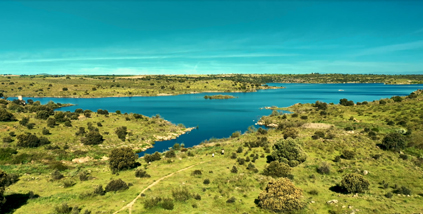
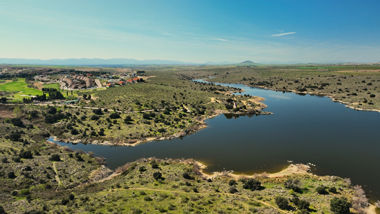
Since 2022, we have been implementing the Guardianes del Tajo (Guardians of the Tagus River) project, a long-term initiative focused on improving water quality, availability, and resilience in the Tagus River watershed. The project is centered around the Guajaraz Reservoir, one of the main water sources for our Toledo Plant, and addresses water challenges at their origin through a combination of restoration, scientific research, and community engagement.
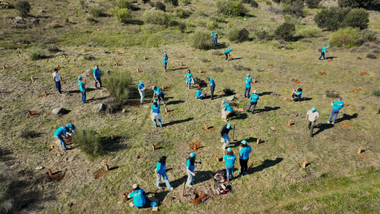
This project is part of our Water Positive approach, which aims to give back more water to nature than we use in our operations by enhancing water resources within the local watershed. Some of the additional actions reflect the wide-ranging nature of the project. These include the development of Suntory Forest, a reforestation initiative in the Guajaraz basin carried out with local stakeholders, as well as the environmental restoration of the Layos stream to reduce erosion and diffuse pollution using native vegetation, or the implementation of the regenerative agriculture on the nearby crops. The project is further strengthened through scientific collaborations with universities, which have enabled hydrological studies and watershed modeling across several nearby basins, improving our understanding of water availability and risks. Together, these initiatives contribute to a more integrated and resilient management of water resources. We also continue to support ecosystem protection efforts in the Júcar River basin near our Carcaixent Plant, by carrying out annual maintenance and improvement work on the previous renovations in that area between 2018 and 2021.
#2
In the Campanarios de Azaba Biological Reserve in the Douro River watershed, we are supporting wetland restoration and biodiversity conservation in collaboration with Fundación Naturaleza y Hombre,
The project includes wetland restoration and creation of Mediterranean ponds (Charcas), reforestation with native species in degraded areas, and environmental education activities in schools across Segovia province —all contributing to water replenishment for our SGS Spanish operations and to greater biodiversity.
These wetlands serve as vital refuges, especially during the dry summer months, providing essential water and habitat for wildlife, including threatened species like the black stork, black vulture, Spanish imperial eagle and Bonelli’s eagle.
Vietnam
Through strong public-private partnerships, we advance our commitment to water sustainability and community well-being through the Water of Life program.
In collaboration with the Ministry of Agriculture and Environment, the Water of Life reforestation initiative focuses on water replenishment, carbon absorption, and livelihood enhancement in Thai Nguyen, Binh Phuoc, Long An, Bac Kan, Nghe An, Ca Mau. By 2025, the program had planted 95 hectares of trees—bringing the total reforested area since 2021 to nearly 200 hectares—and provided training and capacity building for more than 200 households and forest owners.
Belgium
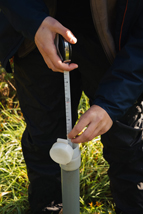
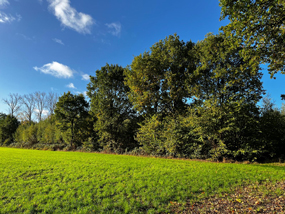
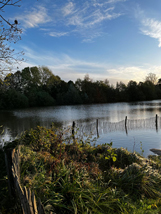
In Belgium, we work with local partners to restore three degraded wetland areas in proximity to our offices to improve water retention, rebuild peat forming processes, and strengthen natural climate resilience. By raising groundwater levels and reversing unnatural drainage, the project enhances biodiversity and boosts the landscape’s ability to store carbon and reduce flood risks. Through education and volunteering, we empower communities to understand and support the vital role healthy wetlands play in protecting both nature and people.
India
In the Gurugram region of northern India, widespread flooding due to heavy rainfall occurs while rapid urbanization and industrial development have led to infrastructure shortages and depletion of natural water sources, causing many residents to face water shortages. Suntory Group implemented a pond restoration project in 2024 to supply agricultural and household water in the Gurugram area. This project restored the degraded pond to improve water supply, enhance water quality, treat wastewater, capture rainwater, and restore biodiversity, significantly increasing groundwater recharge levels. Additionally, a public park was established for residents to enjoy exercise and play, improving the living standards of local farmers and residents and strengthening the community’s economic resilience. Some 25,000-29,000 people visit annually from neighboring villages and community engagement activities included multiple workshops, such as sessions for women on mindful water practices and reducing toxins.
Australia
Starting in 2026, Suntory Group launched water replenishment initiatives in the Brisbane River Catchment with the goal of replenishing more water than the Swanbank Beverage Facility uses annually. It aims to help reduce water consumption and support healthier local water systems through practical, on-the-ground projects with local communities, including restoring waterways, riparian planting, optimizing irrigation and rotating crops. In addition, we partnered with locally based Griffith University’s Australian Rivers Institute (ARI) to support research on the impact of climate change on water quantity and quality.
For more information on community engagement, please see Community Engagement in Watersheds.
Raw Ingredient Production-related Initiatives
Regenerative agriculture is attracting attention for its potential to mitigate and adapt to climate change by reducing GHG emissions through reduced use of chemical fertilizers and pesticides, as well as restoration of soil biodiversity which boosts soil fertility and effective water use. Suntory Group is working to improve the efficiency of water use in production areas through regenerative agriculture, focusing on key raw ingredients (coffee beans, barley, and grapes) that are produced in areas with high water footprints and significant water stress and are important to profitability.
Initiatives for Water Education
Suntory “Mizuiku” - Education Program for Nature and Water
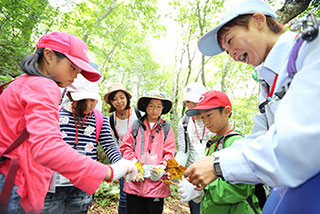
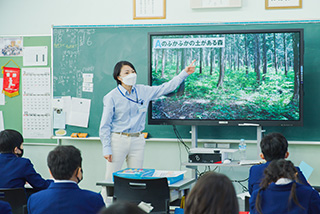
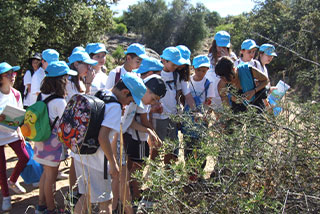
Suntory “Mizuiku”* — education program for nature and water started in 2004 in Japan. The program is unique to Suntory Group and designed to help children think about what they can do to pass on water to future generations. Mizuiku is currently offered in 9 countries worldwide, with cumulative participants exceeding 1,790,000 as of 2025.
-
*Mizuiku is a registered trademark of Suntory Holdings Limited.
-
*Sponsor: Ministry of the Environment, Ministry of Education, Culture, Sports, Science and Technology, etc.
For more information, see Suntory “Mizuiku” — Education Program for Nature and Water.
Community Engagement
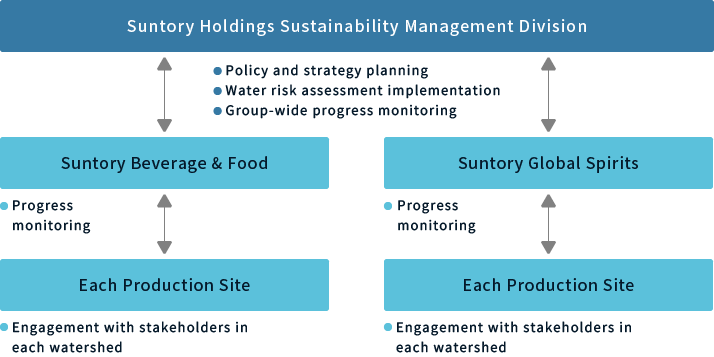
At Suntory Group, we recognize our role as a member of watershed communities and aim to contribute to their development by working alongside diverse stakeholders to conserve local water resources. To formulate policies and strategies for Suntory Group as a whole and conduct water risk assessments, the Sustainability Management Division of Suntory Holdings implements annual assessments at each production site, and based on the results, creates regular opportunities with each operating company to monitor progress for the Group overall. At each production site, we work with stakeholders including local government, NGOs, educational institutions, and the local community to address water-related issues in the local watershed.
Community Engagement Promotion Structure
For more information on community engagement, please see Community Engagement in Watersheds.
Participation in Initiatives
International Water Certification by the Alliance for Water Stewardship (AWS)
In 2018, Suntory Group’s Suntory Okudaisen Bunanomori Water Plant (Tottori Prefecture) became the first in Japan to receive AWS International Certification, followed by the Suntory Kyushu Kumamoto Plant (Kumamoto Prefecture) in 2019 and the Suntory Minami Alps Hakushu Water Plant (Yamanashi Prefecture) in 2021. The Suntory Kyushu Kumamoto Plant obtained the highest “Platinum” certification in 2023, followed by the Suntory Okudaisen Bunanomori Water Plant, Suntory Minami Alps Hakushu Water Plant and Suntory Kita Alps Shinano-no-Mori Water Plant (Nagano Prefecture) in 2025. With this latest achievement, all four of the Group’s water plants in Japan now hold the highest AWS certification. In addition, as Japan’s first corporate member of AWS, Suntory Group has signed onto a partnership with the same organization in February 2021 to raise awareness of water stewardship in Japan, build networks, encourage stakeholder participation, and develop sharable tools. Additionally, in March 2025, 5 Japanese member companies*, including Suntory, launched a working group called Japan Water Stewardship Leadership Group (JWS) to advance efforts to raise Japan’s water conservation efforts to global standards.
- *MS&AD Insurance Group Holdings, Inc., Kurita Water Industries Ltd., Coca-Cola (Japan) Company, Limited, and Yachiyo Engineering Co., Ltd.
About AWS
AWS is an organization founded by corporations and NGOs, including the World Wide Fund for Nature (WWF) and The Nature Conservancy (TNC), to promote water sustainability on a global scale. AWS has developed certification in sustainable water use for factories around the world, and promotes water conservation and stewardship.
For more information, see Achieving the AWS Certification for Water Stewardship.
The CEO Water Mandate
Suntory Group endorsed the CEO Water Mandate global platform, which is a United Nations Global Compact initiative to support the prevalence, practice and informational disclosure of water sustainability at companies.
Water Resilience Coalition
Under the CEO Water Mandate, Suntory Group signed the Water Resilience Coalition (WRC), a convener and strategic enabler that brings companies together to accelerate action, investment, and innovation in water-stressed regions, with the aim of strengthening the resilience of global water resources.
30by30 Alliance for Biodiversity
Suntory Group has participated in the 30by30 Alliance for Biodiversity, which aims to halt and reverse biodiversity loss to realize a sustainable society, since April 2022.
Taskforce on Nature-related Financial Disclosures (TNFD) Forum
Suntory Group joined the Taskforce on Nature-related Financial Disclosures (TNFD)*1 Forum in April 2022 to accelerate initiatives that contribute to nature-positive outcomes. We also registered as a TNFD Adopter*2 in December 2023.
- *1Abbreviation for Taskforce on Nature-related Financial Disclosures.
- *2TNFD Adopters are companies that have registered on the TNFD website their intention to make disclosures based on TNFD recommendations. Registered companies are required to make disclosures based on fiscal year information for 2024 or 2025.
For more information, see Disclosures Based on TNFD & TCFD Recommendations.