



- Water
Establishing Ties with the Community in the “Field” for the Future of Water: Suntory Kita Alps Shinano-no-Mori Water Plant’s Journey to Achieve AWS Certification
Guided by the Suntory Group Sustainable Water Philosophy, Suntory Group conducts initiatives to address water challenges in various regions around the world following 4 pillars—understanding the natural cycle of water, promoting environmentally conscious water use, conserving watersheds, and engaging with the local community.
The Suntory Kita Alps Shinano-no-Mori Water Plant (below, “Kita Alps Shinano-no-Mori Water Plant”), which began producing Suntory Tennensui (Kita Alps) mineral water in May 2021, has been steadily advancing initiatives based on this philosophy while engaging as an active member of the local community. In 2025, the plant received “Platinum” certification, the highest such certification from the international water certification organization Alliance for Water Stewardship (AWS). In this edition, Daisuke Iga from the Engineering Department of the Kita Alps Shinano-no-Mori Water Plant of Suntory Products Limited, who played a central role in the AWS certification project, explains the plant’s activities that are connecting water and nature to the future together with the local community.

A Plant That Coexists with the Forests of the Northern Japan Alps
The Kita Alps Shinano-no-Mori Water Plant is located in a quiet forest in Omachi City, Nagano, surrounded by the Northern Japan Alps, a chain of mountains reaching heights of over 3,000 meters. Surrounded by the colors of every season and the clear mountain air, the plant produces Suntory Tennensui (Kita Alps) mineral water from the pure water that nurtures the region’s rich nature and life. We call this place “the field.” Rain and snow that fall on the mountains seep into the earth, become groundwater, flow into rivers, and eventually return as rain or snow, completing the water cycle to which the plant is intrinsically linked. To protect this connection and continue to pass on this precious gift of nature to people for 100 years to come, the plant is not just a production base, but a “field” that aims to coexist with nature.
The plant is located in Omachi City, Nagano, known as “Shinano Omachi, where the cycle of water begins.” Water has long played a vital role in the region’s development, and local people continue to treasure and protect water as an irreplaceable resource. This approach to water overlaps with the Suntory Group Sustainable Water Philosophy, which is built on 4 pillars: “understanding the natural cycle of water,” “promoting environmentally conscious water use,” “conserving watersheds,” and “engaging with the local community.”
In a region where the culture values water, Suntory is working to pass on the pristine water of the Northern Alps to future generations through various initiatives. These include the “Natural Water Sanctuary” program, which aims to improve water-source conservation functions and restore biodiversity; the “Mizuiku” education program for nature and water at local elementary schools where children learn about the importance of water; and the “Shinano Omachi Mizu-no-Wa Project,” a collaborative effort among companies, universities, and local governments to continuously monitor groundwater conditions. All of these activities are deeply rooted in connections with the local community.

Regarding the Kita Alps Shinano-no-Mori Water Plant, Mr. Iga says, “It’s not just a production base for delivering the gift of water nurtured in the Northern Japan Alps to many people, but also a ‘field’ where water, nature, and people connect to pass on that water to the future.” He notes that employees approach their daily work knowing that the plant is a part of nature.
True Value Lies in Persistent, Day-to-Day Actions
The abundant groundwater in Omachi City is not just a result of nature’s gift. Generations of local residents have made it second nature to protect the mountains and forests and live in harmony with water – a tradition that continues today. The same goes for our plant operations. The day-to-day work of employees maybe invisible to the naked eye, but it plays a vital role in conserving watersheds for the future. Still, simply saying we are “working hard” does not always convey the true value of these efforts. That’s why it’s important to clearly demonstrate how valuable our work is. We want the local community and our colleagues to feel pride and significance in what we have achieved so far, and to be motivated to continue. To that end, we decided to obtain AWS (Alliance for Water Stewardship) international certification, a global water sustainability standard that provides third party evaluation.
Initiatives to Obtain the Highest Platinum Certification
After joining the company, I worked in facility management at the Kanagawa Ayase Plant for 7 years. I was then assigned to the Kita Alps Shinano-no-Mori Water Plant, where I am now in my 4th year. Currently, I’m in charge of energy management and well equipment management. I also serve on the plant’s Environmental Conservation Committee. In my most recent role, I was placed in charge of achieving AWS international certification.
AWS international certification is a water resource sustainability standard adopted by over 300 businesses around the world. It has 3 levels: “Core,” “Gold,” and “Platinum.” Since other Suntory Water Plants have already achieved the highest Platinum certification, the Kita Alps Shinano-no-Mori Water Plant decided to aim for the same in its first application. To be honest, I felt a bit taken aback and pressured by starting with Platinum instead of Core certification. Nevertheless, I decided that “if the activities we have been continuing in this community can be recognized internationally, it is worth the challenge.” All told, I spent about 1 year working on the project.
AWS Values “Coexistence between Companies and Local Communities”
AWS is a certification that emphasizes collaboration between companies and local communities in conserving watersheds. One of its most distinctive features is the audit process, where auditors conduct direct interviews with local stakeholders. The candid feedback from community members forms a key part of the assessment.
For the Kita Alps Shinano-no-Mori Water Plant, everyone living in the watershed is an important stakeholder connected by water. Buildng strong relationships with local governments, water rights holders, farmers, shrine priests, nearby businesses, schools, universities, and the residents of Omachi City, and being a presence that makes people say, “We’re glad Suntory is here,” is the essential foundation for certification.

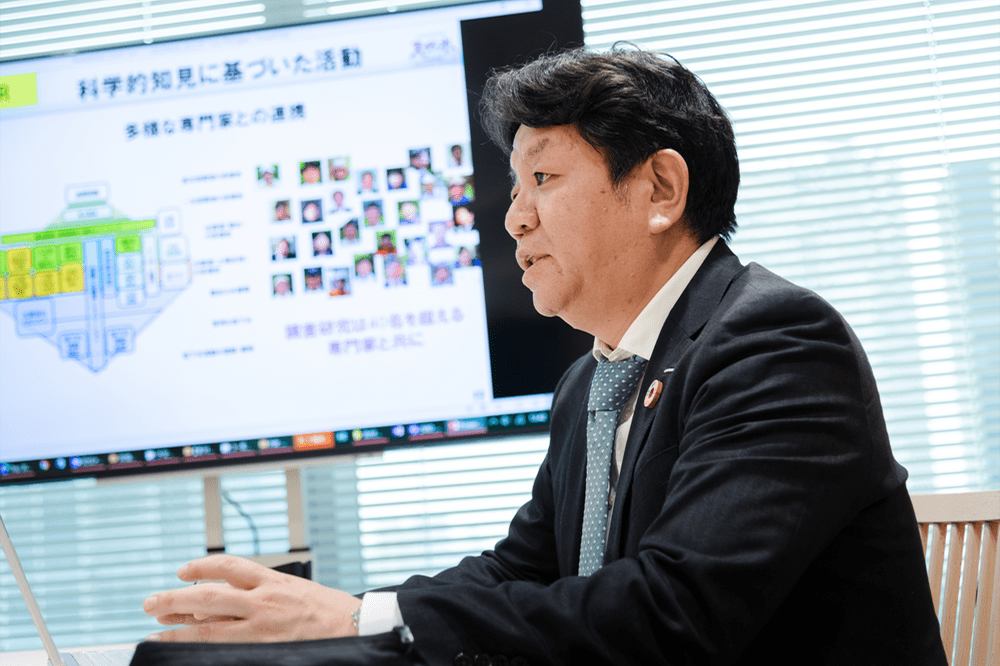
Once a year, the Liaison Council for the Suntory Shinano-no-Mori Plant meets, attended by people from the surrounding area of the plant. It serves as a forum for communicating Suntory’s initiatives and exchanging opinions with local residents. At the meeting held in August 2025, Mr. Iga gave an explanation about Suntory’s initiatives and AWS international certification.
Platinum Certification Achieved through Long-Term Collaboration with the Local Community
The AWS certification audit required an enormous amount of information, making it a challenging process. In reality, my role was to organize and present the efforts we had already been making in a clear and structured way. Achieving Platinum certification was possible thanks to years of collaboration and trust-building with the local community. While the application was submitted under the Kita Alps Shinano-no-Mori Water Plant, this recognition is a testament to the shared efforts of both the plant and the community—a result we are truly proud of.
How AWS Experience Changed My Perspective on Nature and Community
Through the process of achieving AWS certification, my own perspective has also shifted. I now take even more action with a focus on what Suntory and this region can accomplish together. At times, I guide children visiting on school field trips, and their simple questions and impressions often spark ideas for future challenges we should take on. This experience has also strengthened my desire to make the plant a source of pride for the local community. We will continue to build value hand in hand with local residents so that the people of Omachi City feel glad that Suntory is here. AWS certification is just one of milestones. Our goal is to continue to be a plant that exists together with the local community. Going forward, rather than extraordinary actions, we will keep doing the ordinary, day-to-day work with care. We believe that these steady efforts will lead to a solid step toward a sustainable future.

The Shinano-no-Mori Water Plant achieves net-zero CO2 emissions through the installation of solar power generation facilities, the use of biomass-fueled boilers, procurement of electricity from renewable sources, and the utilization of carbon offsets.
At the Suntory Northern Alps Factory Festival at the Shinano-no-Mori Water Plant, Mr. Iga personally explained to visitors the workings of the biomass boiler that utilizes thinned wood produced in the region. He was elated to have the valuable opportunity to talk directly with customers and that everyone listened attentively.
Latest Stories
-
- Water
- Biodiversity
July 14, 2026
Sustaining Water and Wildlife for the Future: Suntory’s Nature Positive Initiatives at Our Natural Water Sanctuary Aso (Part II)
-
- Water
- Biodiversity
July 14, 2026
Sustaining Water and Wildlife for the Future: Suntory’s Nature Positive Initiatives at Our Natural Water Sanctuary Aso (Part I)
-
- Water
January 29, 2026
Establishing Ties with the Community in the “Field” for the Future of Water: Suntory Kita Alps Shinano-no-Mori Water Plant’s Journey to Achieve AWS Certification
-
- Water
- Climate Change
October 28, 2025
Launch of Suntory’s Green Hydrogen Park Hakushu: A New Journey in Energy “Born from Water, Returning to Water”
-
- Water
August 22, 2025
Empowering Society with Suntory's Knowledge and Expertise in “Water”: Passing on Water Landscapes to Future Generations
-
- Packaging
June 17, 2025
Closing the Loop with “Bottle to Bottle” Horizontal Recycling: Insights into Resource Value from the Frontlines
-
- Enriching Life
- Water
- Raw Ingredients
- Packaging
April 17, 2025
Suntory’s Commitment to “Designing Future Society for Our Lives”: Encouraging New Realizations through Exciting New Experiences at Expo 2025
-

March 31, 2025
The Suntory Sign Brings Smiles and a Sense of Unity
-
- Climate Change
- Raw Ingredients
Februaly 28, 2025
Shaping the Future of Japanese Wine: Secondary Induced Shoot Cultivation Delivers Delicious Grapes in an Era of Climate Change
-
- Water
- Climate Change
January 31, 2025
Bequeathing Water to Future Generations and Conveying Its Importance through Mizuiku, Suntory’s Education Program for Nature and Water
-
- Climate Change
- Raw Ingredients
December 25, 2024
Saving the Planet with Agriculture:Collaborating with Farmers to Pioneer Regenerative Agriculture
-
- Climate Change
- Raw Ingredients
October 11, 2024
The Key for Domestically Producing Sustainable Botanical Raw Materials: Glocal Branding
-
- Water
- Climate Change
- Raw Ingredients
June 7, 2024
The Peatland Water Sanctuary™ Initiative: For Peat, an Important Ingredient in Whisky, and for the Future of the Planet
-
- Enriching Life
April 30, 2024
Enhancing the Foundation of Parasports with the Suntory Challenged Sports Project
-
- Raw Ingredients
- CO2
- Biodiversity
November 30, 2023
Protecting UK Blackcurrants and Their Growers: Sustainable Agriculture Support Program
-
- Human Rights
September 29, 2023
Being the Best Company for Employees with Disabilities to Shine
-
- Water
July 31, 2023
Suntory Mizuiku – Education Program for Nature and Water Expands Globally: Stories from Asia
-
- Health
June 29, 2023
New DRINK SMART Ambassador Program: Internal Certification to Deliver the DRINK SMART Message to More Customers
-
- Raw Ingredients
- CO2
June 29, 2023
Circular Agriculture Initiatives at Tominooka Winery in Japan (Part 2)
-

- Biodiversity
May 10, 2023
Suntory Bird Conservation Activities Are Turning 50: A Look at the Past and the Future (Part 2)
-
- Raw Ingredients
- CO2
April 27, 2023
Circular Agriculture Initiatives at Tominooka Winery in Japan (Part 1)
-

- Health
April 27, 2023
Creating “Friends for Moderate Consumption,” a Campaign Character to Promote Responsible Drinking
-

- Packaging
April 27, 2023
B to B Recycling: Creating New PET Bottles from Used Bottles
-

- Human Rights
April 27, 2023
SUN-co-NEsT, An Online Community Aiming to Balance Work and Parenting
-
- Biodiversity
April 27, 2023
Suntory Bird Conservation Activities Are Turning 50: A Look at the Past and the Future (Part 1)
-
- Water
- Biodiversity
April 27, 2023
Protecting the Forests That Nurture Abundant Water: Suntory Natural Water Sanctuary Initiative


