



- Water
- Biodiversity
Sustaining Water and Wildlife for the Future: Suntory’s Nature Positive Initiatives at Our Natural Water Sanctuary Aso (Part II)
Our efforts to replenish groundwater through forests and rice paddies have helped bring back waterside wildlife. Rich ecosystems can only flourish when supported by a healthy underlying environment. Suntory is collaborating with researchers and the local community to go one step further and restore wetland habitats. Continuing from Part I, Naoki Saegusa, Expert Senior Specialist in the Natural Water Sanctuary Group within Suntory Holdings Limited’s Sustainability Management Division, describes Suntory Group’s activities.

From Winter-Flooded Paddies to Wetland Restoration
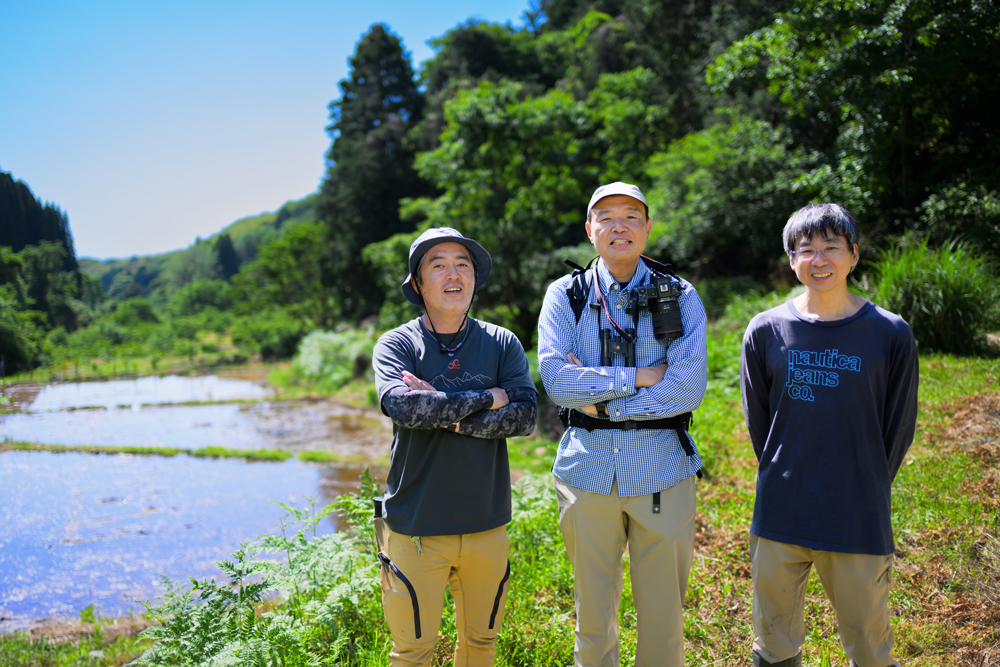
As we continued our winter-flooded paddies initiative, a new idea began to take shape: the rice paddies have to be drained for part of the year for farming, but if we could create a more stable waterside environment somewhere nearby, which could remain flooded all year round, couldn’t we create a paradise for waterside wildlife? With this in mind, we looked around and eventually found a nearby village with rice paddies that had been left uncultivated for many years. We then considered restoring the area—not as farmland, but as a wetland that could serve as a habitat for the species native to the area. Keeping the area flooded year-round would also help replenish groundwater. In this way, we saw the potential to create an initiative that supports both groundwater replenishment and biodiversity restoration. We immediately began discussions with Dr. Yuichi Kano (Kyushu Open University) of the research platform Catchment based Flood Management for Sustainable Society, who has been leading biodiversity surveys of our winter-flooded paddies, along with local farmer Mr. Kazuaki Iwamura and other members of the community. I would like to invite Dr. Kano and Mr. Iwamura to share the results of those talks!

At the newly established wetland area. From left: Mr. Iwamura, Mr. Saegusa, Dr. Kano
Mr. Kazuaki Iwamura

We’ve been collaborating with Suntory on the winter-flooded paddies initiative for around 15 years, since before I took over the farm from my parents. Working together for all these years has built up a relationship of trust between us, as partners on a shared journey. Mr. Saegusa has been involved right from the start, so by this point we always stop to talk if he shows his face in the village. He’s a part of the community!
I understand that water is an important raw material that supports their business. And that’s the same for us in the farming community. If we don’t have water, we can’t do a thing. While Suntory has their Sustainable Water Philosophy, we have our own concept: “water comes from the forest.”
In the old days, around here, we used to call the frogs and other wildlife that would come to the rice paddies “tangyaku,” which means “guests of the paddies.” To the rice paddies, these creatures were welcome guests. Today, however, we have rice paddies left untended for various reasons, including the fact that our farming population is growing older. These have gradually become overgrown, and the tangyaku stopped dropping by.
As this was happening, Mr. Saegusa and Dr. Kano, who does the wildlife surveys as part of the winter-flooded paddies initiative, came to me with a suggestion. We could restore the unused rice paddies within the Natural Water Sanctuary as wetlands.
When I talked to the rest of the village and explained that creating a wetland might bring back our tangyaku, the faces of our older community members lit up instantly. “I want to see the landscapes of my childhood again,” they told me.
Nothing would be more rewarding than to see the everyday scenes of their childhood restored: the dragonflies dancing at the water’s edge, the chorus of the frogs.
I see this as a grand and ambitious project, to use our time here to sustain the living things that make their homes in our area, for the next generation. I’d like to help this become a place bustling with lots of our “welcome guests.”

A restored wetland area surrounded by our Natural Water Sanctuary. Previously a stretch of wasteland overgrown with grasses, this traditional rural landscape was restored by the villagers, Dr. Kano, and Suntory working together to mow the grass and repair the disused waterways.

Wetland restoration is about “sustaining life,” says Mr. Iwamura. “These huge trees around us have been preserved from however many generations ago, all the way to the present. When I think of that, I have a real sense of our own efforts stretching out 100 years into the future.”
Dr. Yuichi Kano, the research platform Catchment based Flood Management for Sustainable Society, Kyushu Open University

I research freshwater species and ecosystems in rivers, rice paddies, and waterways. Since 2020, I have been working with Suntory to conduct biodiversity surveys of winter-flooded paddies.
Without water, humans and other living things can’t survive. There are many theories around protecting the waters that are so crucial to us, and I study this area myself. However, it’s not easy to put theory into practice when you’re working with nature. What stands out to me is that Suntory has continued these efforts for years, with their truly “on-the-ground” Natural Water Sanctuary and winter-flooded paddy initiatives. Their attitude of prioritizing this on-the-ground, practical approach is one that really resonates with me. Replenishing groundwater is not the kind of thing where you see results in 1 or 2 years. With wetland restoration, too, wildlife is not going to come back immediately just because you’ve flooded the area. Even so, Suntory continues to invest time and effort. This is an approach you can put your trust in.
Today, freshwater wetland environments worldwide are in a critical state, and almost half of the amphibian and aquatic reptile species found in Japan are considered endangered. However, as scientific data have not fully caught up with the current situation, I believe the actual figure may be even higher, possibly exceeding half. On the other hand, I sometimes get asked why we should make such efforts to protect biodiversity. I believe that biodiversity and nature have intrinsic value in their own right. Simply put, bringing back biodiversity through winter-flooded paddies and restoring wetlands has enormous value. And in order to achieve this, we need the involvement of a wide range of stakeholders, and not just researchers. We can only succeed through collaborative efforts between researchers, businesses, and communities.
I believe this wetland restoration initiative could serve as a model not only within Japan but for the rest of the world, too. I hope many communities will learn from our work.

An endangered Japanese diving beetle that visited the newly established wetland. “This is amazing. I’m so happy it’s flown in to visit the site.”
Looking 100 Years Ahead: Forest Management on Nature’s Timeline
I have been involved in this initiative for over 20 years, and I believe there is real value in long-term engagement. Nature works on very long timescales, after all. If you plant saplings, they will still be young trees at about the 3-year mark, and it takes around 20 years for them to finally grow into a forest. Only by observing these long-term changes can we learn what works and what to do next. Relationships with local communities are the same. Visiting again and again over time lets you gradually get acquainted and grow closer to people. The kind of relationship where you naturally stop and chat when you see each other generally takes time to build.
Suntory has people—like our whisky distillers—who dedicate themselves to continually refining their skills in a single specific field. It is not unusual to see someone who has been involved in Suntory Natural Water Sanctuary for over 20 years! I think the fact that they can work in this way over the long term, on nature’s timeline, reflects something essential about Suntory.
Thinking ahead to 100 years from now, we are supporting environments that can sustain the future of both water and life, for the next generation. I believe these efforts, built over time, will lead to Nature Positive outcomes.


Latest Stories
-
- Water
- Biodiversity
July 14, 2026
Sustaining Water and Wildlife for the Future: Suntory’s Nature Positive Initiatives at Our Natural Water Sanctuary Aso (Part II)
-
- Water
- Biodiversity
July 14, 2026
Sustaining Water and Wildlife for the Future: Suntory’s Nature Positive Initiatives at Our Natural Water Sanctuary Aso (Part I)
-
- Water
January 29, 2026
Establishing Ties with the Community in the “Field” for the Future of Water: Suntory Kita Alps Shinano-no-Mori Water Plant’s Journey to Achieve AWS Certification
-

- Water
- Climate Change
October 28, 2025
Launch of Suntory’s Green Hydrogen Park Hakushu: A New Journey in Energy “Born from Water, Returning to Water”
-
- Water
August 22, 2025
Empowering Society with Suntory's Knowledge and Expertise in “Water”: Passing on Water Landscapes to Future Generations
-

- Packaging
June 17, 2025
Closing the Loop with “Bottle to Bottle” Horizontal Recycling: Insights into Resource Value from the Frontlines
-
- Enriching Life
- Water
- Raw Ingredients
- Packaging
April 17, 2025
Suntory’s Commitment to “Designing Future Society for Our Lives”: Encouraging New Realizations through Exciting New Experiences at Expo 2025
-

March 31, 2025
The Suntory Sign Brings Smiles and a Sense of Unity
-
- Climate Change
- Raw Ingredients
Februaly 28, 2025
Shaping the Future of Japanese Wine: Secondary Induced Shoot Cultivation Delivers Delicious Grapes in an Era of Climate Change
-
- Water
- Climate Change
January 31, 2025
Bequeathing Water to Future Generations and Conveying Its Importance through Mizuiku, Suntory’s Education Program for Nature and Water
-
- Climate Change
- Raw Ingredients
December 25, 2024
Saving the Planet with Agriculture:Collaborating with Farmers to Pioneer Regenerative Agriculture
-
- Climate Change
- Raw Ingredients
October 11, 2024
The Key for Domestically Producing Sustainable Botanical Raw Materials: Glocal Branding
-
- Water
- Climate Change
- Raw Ingredients
June 7, 2024
The Peatland Water Sanctuary™ Initiative: For Peat, an Important Ingredient in Whisky, and for the Future of the Planet
-
- Enriching Life
April 30, 2024
Enhancing the Foundation of Parasports with the Suntory Challenged Sports Project
-
- Raw Ingredients
- CO2
- Biodiversity
November 30, 2023
Protecting UK Blackcurrants and Their Growers: Sustainable Agriculture Support Program
-
- Human Rights
September 29, 2023
Being the Best Company for Employees with Disabilities to Shine
-
- Water
July 31, 2023
Suntory Mizuiku – Education Program for Nature and Water Expands Globally: Stories from Asia
-
- Health
June 29, 2023
New DRINK SMART Ambassador Program: Internal Certification to Deliver the DRINK SMART Message to More Customers
-
- Raw Ingredients
- CO2
June 29, 2023
Circular Agriculture Initiatives at Tominooka Winery in Japan (Part 2)
-

- Biodiversity
May 10, 2023
Suntory Bird Conservation Activities Are Turning 50: A Look at the Past and the Future (Part 2)
-
- Raw Ingredients
- CO2
April 27, 2023
Circular Agriculture Initiatives at Tominooka Winery in Japan (Part 1)
-

- Health
April 27, 2023
Creating “Friends for Moderate Consumption,” a Campaign Character to Promote Responsible Drinking
-

- Packaging
April 27, 2023
B to B Recycling: Creating New PET Bottles from Used Bottles
-

- Human Rights
April 27, 2023
SUN-co-NEsT, An Online Community Aiming to Balance Work and Parenting
-
- Biodiversity
April 27, 2023
Suntory Bird Conservation Activities Are Turning 50: A Look at the Past and the Future (Part 1)
-
- Water
- Biodiversity
April 27, 2023
Protecting the Forests That Nurture Abundant Water: Suntory Natural Water Sanctuary Initiative


